Bougainvillea Bloom in Monsoon Season — Kolkata & West Bengal...
Monsoon rain is the enemy of bougainvillea blooms. This guide explains how to protect your plant during Bengal's June–September rainy season and time the October dry-stress window to trigger the most spectacular flush of the year.
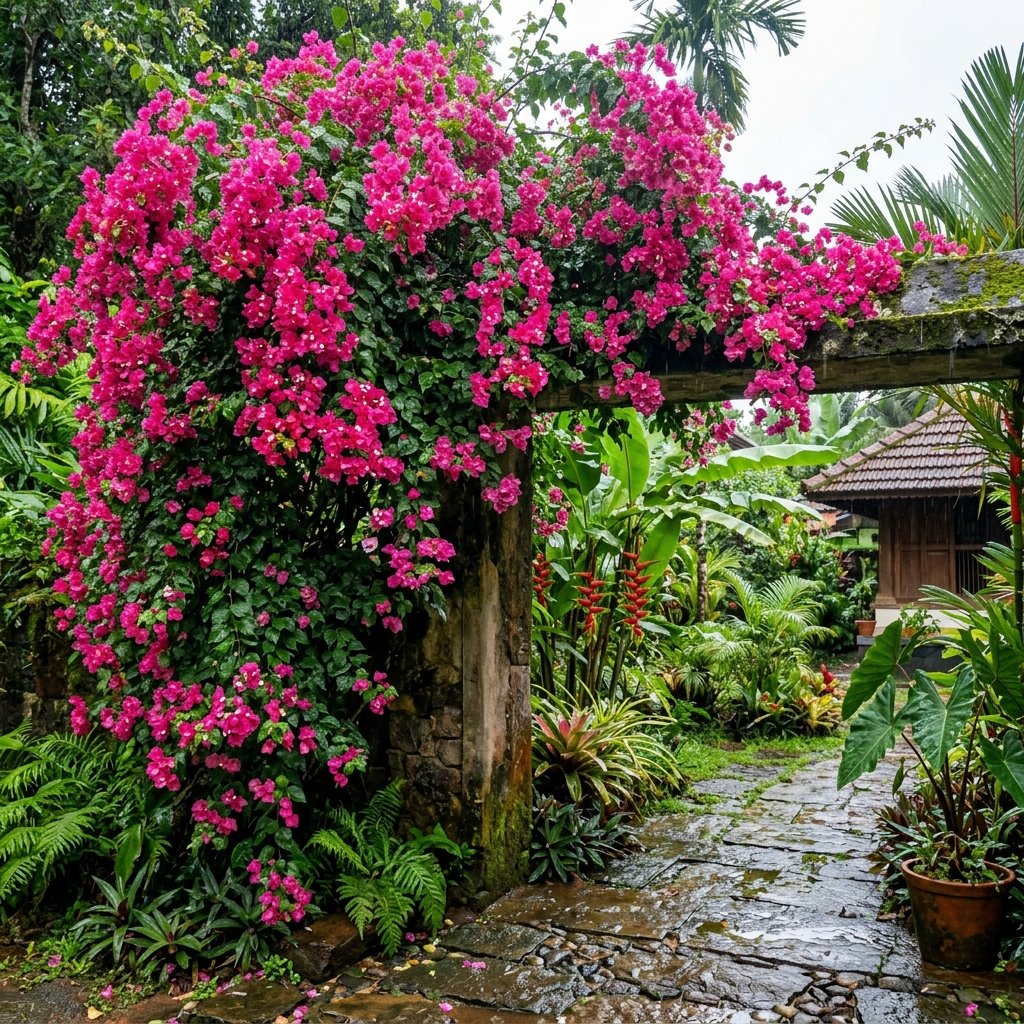
Quick Answer
Bougainvillea rarely blooms heavily during the monsoon itself because constant rain prevents the drought stress it needs. Your strategy: protect the root zone from waterlogging (raise the pot, improve drainage), prune hard in late September when rains retreat, then cut watering sharply for 3 weeks in October. This triggers the best bloom flush of the year — typically appearing mid-to-late October in Kolkata.
The Monsoon Paradox
If you grow bougainvillea in Kolkata or anywhere in West Bengal, you already know the frustration. Your plant is green, healthy, and seemingly full of potential — but from June to September, it refuses to bloom. Meanwhile, photos on Instagram show bougainvilleas covered in bracts. What's going wrong?
Nothing. Bougainvillea is doing exactly what it should during constant rain: surviving, not reproducing. The plant blooms in response to mild drought stress — a temporary reduction in soil moisture that signals to the plant that conditions are right for flowering. When rain falls every day, that signal never arrives. The plant stays green and leafy, waiting.
The good news: monsoon season in Bengal is not the enemy of blooms. It is the setup for them. If you manage the plant correctly from June to September, you can trigger the most spectacular bloom flush of the entire year in October and November.
Why Monsoon Suppresses Blooming
Bougainvillea originates from the dry coastal regions of Brazil. Its native climate has a pronounced dry season, which is when it blooms most heavily. In that environment, blooming is a reproductive strategy — the plant flowers when water becomes scarce, ensuring pollination before the next drought period.
In a Kolkata monsoon, the soil stays wet for days at a stretch. Oxygen in the root zone is reduced. The plant shifts into a defensive growth mode, pushing leaves and roots rather than flowers. Adding fertilizer at this point only worsens the situation — nitrogen in wet soil produces long, soft, leafy shoots with zero bracts.
Monsoon Care: What to Do June–September
1. Control Waterlogging — This is Non-Negotiable
The single biggest killer of Kolkata bougainvillea during monsoon is not the rain itself but the standing water in pots and the ground around them. Waterlogged roots rot within 5–7 days. Once root rot sets in, bloom recovery takes months, not weeks.
- Raise all pots off the ground using bricks or pot feet. Even 5 cm of elevation dramatically improves drainage after heavy rain.
- Check drainage holes monthly — they frequently get clogged by soil and moss in humid weather. Poke them clear with a skewer.
- If potting mix retains water for more than 2 days after rain stops, repot immediately into a mix with 40% perlite or coarse sand. Do not wait for the monsoon to end.
- Ground-planted bougainvillea in heavy clay soil (common in Bengal) should have a shallow trench dug around the base to channel rainwater away from the root zone.
2. Move Pots Under Roof Overhang (Partially)
If you have a covered balcony or a roof overhang, move pots partially under it during peak monsoon (July–August). This does not mean full shade — the plant still needs as much sun as possible. The goal is to reduce the volume of water hitting the pot while keeping the plant in light. Even filtering 40% of direct rainfall makes a measurable difference in soil drying speed.
3. Pause Fertilizer Completely During Heavy Rain Periods
Do not fertilize during the monsoon. Nutrients applied to waterlogged soil either wash straight out or, worse, create salt accumulation as drainage fluctuates. Save your fertilizer budget for September and October when it will actually matter.
4. Prune for Structure, Not Bloom
Monsoon is an excellent time for light structural pruning — removing crossing branches, dead wood, and any stems showing signs of fungal rot. Do not hard-prune for bloom induction during active rain. Instead, thin the canopy to improve airflow, which reduces the powdery mildew and leaf spot that thrive in Bengal's October humidity surge.
The October Window: Triggering the Big Flush
This is where everything changes. In most years, Kolkata sees the last significant monsoon rains in late September or early October. The moment rain frequency drops — not after it has fully stopped, but as it becomes intermittent — your window for bloom induction opens.
Step 1: Hard Prune in Late September (Week 1 of Window)
Cut back all long, leafy monsoon growth by 30–40%. Focus on the soft, elongated shoots that grew during the rainy season — these will never bloom well as they are. Cut to a node just above a healthy leaf. This prune creates dozens of new growing tips, each a potential bloom site. After pruning, remove all fallen leaves from the pot surface to prevent fungal carry-over.
Step 2: Apply a Phosphorus Boost (Week 1–2)
Within 3–5 days of pruning, apply a single dose of high-phosphorus fertilizer. In the Indian market, look for DAP (Diammonium Phosphate, 18:46:0) at 1 gram per litre of water, or bone meal scratched into the top soil (1–2 tablespoons per 30cm pot). This feeds the new growth immediately without pushing nitrogen-heavy leaves.
Step 3: Begin the Dry Stress Cycle (Week 2–5)
This is the most important step. After the phosphorus feed, stop watering. Wait until the plant shows its first signs of mild morning droop — this is not wilting but a slight softening of the newest leaves in the early morning hours. When you see this, water deeply once, then stop again. Repeat this cycle for 3–4 weeks.
In October in Kolkata, with temperatures typically 28–33°C and humidity dropping from monsoon peaks, a 30cm terracotta pot will usually dry to the stress point in 5–7 days. A plastic pot may take 8–10 days. Adjust by feel, not by the calendar.
Step 4: Maximise Sunlight
Move pots to the sunniest spot available — south or west-facing terrace or balcony, away from any shade from walls or trees. Post-monsoon October sun in Bengal is strong and reliable. Every additional hour of direct sun from 9am–3pm accelerates bud development.
Expected Timeline
| Week | Action | What to Expect |
|---|---|---|
| Week 1 (late Sept) | Hard prune 30–40%, clear fallen debris | Visible pruning cuts, plant looks smaller |
| Week 2 | Single phosphorus feed, begin dry cycle | New growth tips emerging from cut nodes |
| Week 3–4 | Continue dry stress cycle (water only at morning droop) | Shoots hardening, leaves becoming slightly smaller and darker |
| Week 5–6 (mid-October) | Maintain stress, full sun | Bract colour visible on shoot tips |
| Week 7–8 (late October) | Continue care, do not prune or disturb | Full bloom flush — peak display |
Common Mistakes That Kill the October Flush
- Watering on a fixed schedule instead of observing the plant. If October brings unexpected rain, skip your watering entirely that week.
- Pruning during active bloom — wait until the flush has fully faded before the next prune cycle.
- Applying nitrogen fertilizer in October — this restarts vegetative growth and delays bracts by 6–8 weeks.
- Leaving the plant in a shaded spot because you are protecting it from heat. Post-monsoon October heat in Bengal (28–33°C) is ideal bougainvillea blooming temperature — it is not a threat.
- Repotting in October — repotting stress interrupts the bloom signal. If the plant needs repotting, do it in late November after the flush fades, or wait until February.
What About a Second Flush?
After the October–November flush fades (usually by December), Bengal temperatures drop to 15–22°C at night. This is the perfect recovery window. Give the plant a light prune in late November, a single balanced feed (19:19:19 at half strength), and water normally. A smaller second flush often appears in February–March, just before the pre-summer heat sets in. This is the plant's natural two-flush rhythm in Bengal's climate.
Monsoon is not the enemy of bloom — it is the preparation for it. Survive the rain well, and your October flush will be the best one your plant has ever produced.
Recommended next actions
Next Best Actions
Move from reading to action with related calculators, plant profiles, and quiz-based recommendations.
Calculator
Bougainvillea Watering Schedule Calculator
Calculate exactly when to water your Bougainvillea using the proven Dry-to-Bloom method.
Plant Guide
'Adarna' (Shikendari)
Bougainvillea 'Adarna' (Shikendari) is a rare collector's cultivar prized for its spectacular multicoloured bracts that shift between yellow, orange, and deep pink-magenta. A prolific bloomer for hot, full-sun gardens, fences, and large containers across tropical India.
Plant Guide
Chitra India
This Chitra India bougainvillea is valued for its bright pink to magenta bracts and its vigorous climber with strong repeat bloom. In warm tropical and subtropical gardens, it performs as a resilient ornamental climber that rewards full sun, sharp drainage, and a restrained feeding regime with long flushes of colour.
Plant Guide
Red September
This Red September bougainvillea is valued for its scarlet to deep red bracts and its bold, high-impact climber with strong bloom cycles. In warm tropical and subtropical gardens, it performs as a resilient ornamental climber that rewards full sun, sharp drainage, and a restrained feeding regime with long flushes of colour.
Calculator
Bougainvillea Heat Stress & Watering Calculator
Diagnose heat stress in potted Bougainvilleas during extreme summer weather.
Calculator
Bougainvillea Garden Mulch Calculator
Calculate exact mulch volumes while learning how to apply it safely around Bougainvilleas.