Bougainvillea Bonsai: Complete Beginner's Guide (India-Friendly)
Bougainvillea makes a spectacular bonsai — fast-growing, drought-tolerant, and capable of producing vivid bracts even in a tiny pot. This guide covers species selection, soil, root pruning, wire training, and seasonal care for Indian conditions.
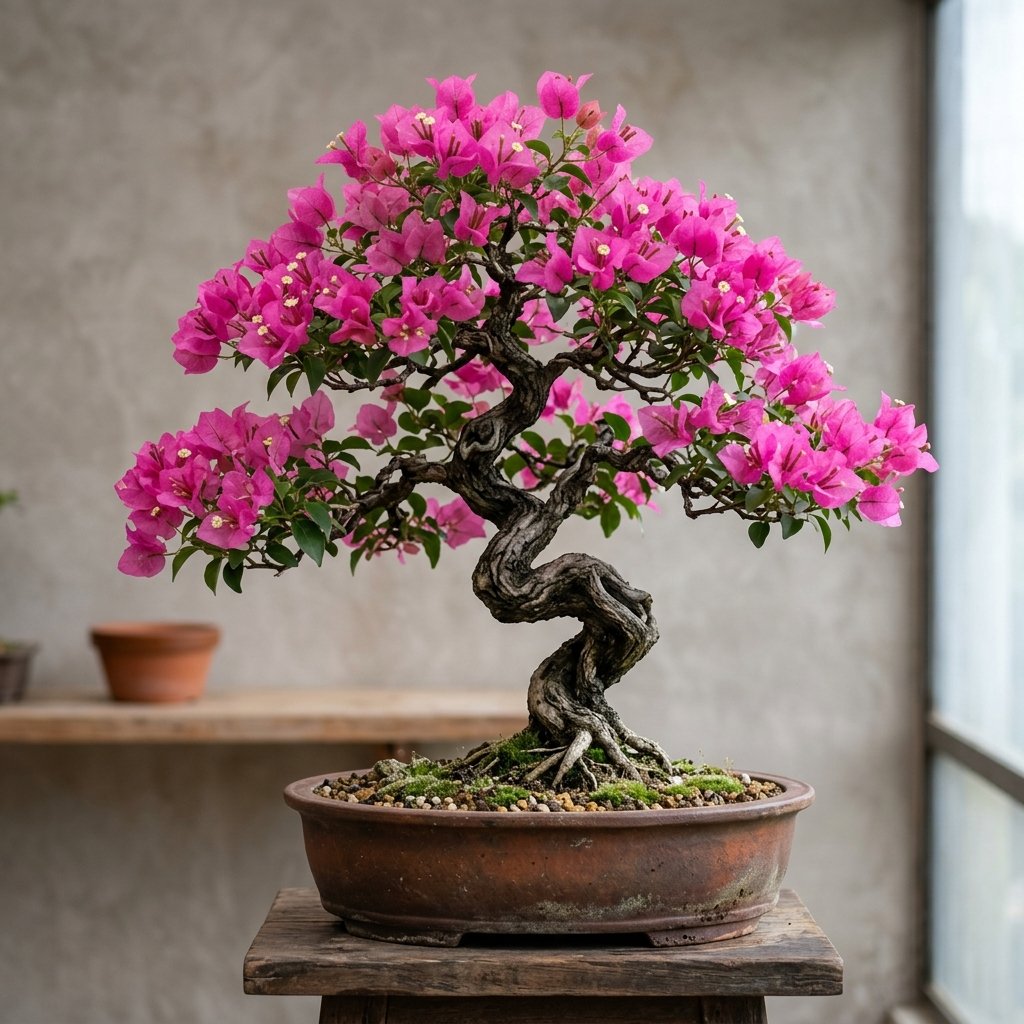
Quick Answer
Bougainvillea glabra is the best species for bonsai beginners — it has naturally smaller internodes, back-buds vigorously, and tolerates root pruning well. Use a fast-draining bonsai mix (60% akadama or coarse grit + 40% potting soil), wire in early spring, root-prune every 2 years, and trigger blooms with the same drought-stress method used for regular plants.
Why Bougainvillea Makes an Exceptional Bonsai
Most bonsai practitioners in India overlook bougainvillea in favour of Ficus, Jade, or Fukien Tea. This is a missed opportunity. Bougainvillea brings two qualities to bonsai that few other tropical species match: extraordinary bloom production in a miniature form, and a forgiving constitution that survives aggressive root pruning and styling.
A well-developed bougainvillea bonsai at 3–4 years old can produce the same density of bracts as a full-sized garden plant, compressed into a pot that sits comfortably on a balcony railing. The gnarled, naturally twisting trunk and thorny branch structure look ancient even on young specimens — exactly what bonsai aesthetics demand.
Best Species for Bougainvillea Bonsai
Bougainvillea glabra — Best for Beginners
B. glabra (also sold as 'Sanderiana' or 'Magnifica' in Indian nurseries) has naturally compact internodes — the distance between leaf nodes on each branch is shorter than other species. This means a more refined branching structure with less work. It back-buds vigorously after pruning, creating new branches easily. Bloom colours range from magenta-pink to purple. Highly recommended as your first bougainvillea bonsai.
Bougainvillea spectabilis — Beautiful but Challenging
B. spectabilis produces larger leaves and longer internodes, making it harder to achieve the fine branching typical of good bonsai form. However, its naturally larger trunk girth and dramatic bloom displays make mature specimens stunning. Better suited for intermediate practitioners who have already worked with B. glabra.
Dwarf / Miniature Varieties
Varieties like 'Helen Johnson', 'Vera Deep Purple', and 'Bambino' series are genetically compact and work well for very small bonsai (shohin scale, pots under 15cm). Their naturally short internodes and dense growth habit need less wire training. Available at specialty nurseries in major Indian cities.
Selecting Your Starting Material
You have three options for starting a bougainvillea bonsai:
- Nursery stock (easiest): Buy a 2–3 year old plant from a nursery, select one with an interesting trunk movement, and begin bonsai training. Expect your first bloom display within 1–2 years of starting.
- Collected material (advanced): Digging up a mature plant from the ground with an established root system and thick trunk. Requires root pruning skills and patience through recovery.
- Cuttings (slowest, most rewarding): Root a 15–20cm semi-hardwood cutting, allow it to establish for 1 year in a training pot, then begin bonsai styling. Takes 3–4 years to a presentable bonsai but gives you complete control over the form from the beginning.
Bonsai Soil Mix for Indian Conditions
This is where most beginners fail. Standard potting soil holds too much moisture for bonsai culture — it will cause root rot in the confined pot environment, especially during India's monsoon season.
Recommended mix for bougainvillea bonsai:
- 50% akadama (Japanese bonsai clay, available online in India) or coarse river sand or granite grit (2–4mm particle size)
- 30% potting soil (not garden soil — use a well-draining commercial mix)
- 20% small pine bark or coco husk chips
If akadama is too expensive or hard to find locally, substitute with washed poultry grit (readily available at agricultural suppliers across India for ₹30–60/kg) — it is essentially coarse granite particles in the right size range.
Pot Selection
Bonsai pot selection is both aesthetic and functional for bougainvillea:
- Depth: Shallow pots (4–6cm depth) restrict root growth and naturally trigger more blooming. However, very shallow pots dry out extremely quickly — especially in hot Bengal summers — requiring twice-daily watering during peak heat. Start with a medium-depth pot (8–10cm) and move shallower as the tree matures.
- Material: Unglazed terracotta or stoneware allows some air exchange through the pot walls, which bougainvillea roots appreciate. Avoid fully glazed pots for young training specimens.
- Drainage: Bonsai pots must have generous drainage holes. Bougainvillea in particular will die in a pot that holds water even for 24 hours. Mesh the drainage holes with plastic bonsai mesh before potting.
- Size: The pot should be roughly 2/3 the width of the tree's widest spread. Oversized pots hold excess soil moisture and slow bloom production.
Root Pruning
Root pruning is the most intimidating part of bougainvillea bonsai for beginners — but the plant handles it remarkably well if done at the right time and with good aftercare.
When to Root Prune
The best time in India is late February to early March — just as new growth is beginning to emerge but before the pre-summer heat spike. In West Bengal, this means the window is roughly February 15 to March 10.
How Much to Remove
For a first root prune: remove no more than 30% of the total root mass. For subsequent repottings (every 2–3 years): you can remove up to 40–50% of circling and fibrous roots. Always prioritize removing downward-growing tap roots (which are not useful in a shallow bonsai pot) and circling roots that are girdling the root ball.
After Root Pruning
Repot immediately into fresh bonsai mix. Water thoroughly. Place in a shaded spot (no direct sun) for 10–14 days while new feeder roots establish. Resume normal sun exposure gradually. Do not fertilize for 4–6 weeks after root pruning. Expect some leaf drop — this is normal and the plant will recover.
Wire Training and Styling
Bougainvillea branches are somewhat brittle and should be wired when they are still green and flexible (less than 6 months old). Older wood snaps easily.
- Wire gauge: Use aluminium wire (1–2mm for small branches, 2.5–3mm for main branches). Copper wire is stronger but harder to work with for beginners.
- Wiring season: Wire in early spring (February–March in India) when new growth is beginning. This gives the branch the whole growing season to set into the new position.
- Remove wire before it cuts into the bark — check monthly. Bougainvillea bark is relatively thin and wire marks will develop quickly in the growing season.
- Recommended styles: Informal upright (moyogi) and slanting (shakan) work naturally with bougainvillea's organic, twisting growth habit. Avoid very formal styles — the natural character of the plant fights against straight lines.
Bloom Induction for Bonsai
The same drought-stress method used for regular bougainvillea applies directly to bonsai — but the scale is much smaller, so timing is tighter. A bonsai pot dries out much faster than a regular pot.
- In October (post-monsoon in India): prune back soft monsoon growth by 30%, apply a half-dose of bone meal, then begin the dry cycle (water only at morning droop).
- Because bonsai pots are shallow, morning droop may appear in just 2–3 days in October. Do not let the tree dry beyond morning droop — severe wilting in a bonsai pot can be fatal.
- Once bracts begin forming, water more regularly — the plant is using moisture faster during bloom.
Seasonal Care Calendar for Indian Bougainvillea Bonsai
| Season (India) | Key Tasks | Watch For |
|---|---|---|
| Jan–Feb | Light prune, repot if needed, begin feeding with balanced fertilizer | February bloom flush |
| March–May | Wire young branches, increase feeding (bone meal + potassium), full sun | Pre-summer heat stress — shade after 2pm in peak May |
| June–Sept | Raise pots, monitor drainage, pause fertilizing, check for root rot | Waterlogging — the biggest monsoon threat |
| Oct–Nov | Hard prune monsoon growth, phosphorus boost, begin dry cycle, full sun | October bloom flush — protect from unexpected rain |
| Dec | Light feed, minimal watering, enjoy winter calm | Temperature drop below 10°C — bring indoors in North India |
A bougainvillea bonsai that has been trained for 3–4 years and is in full October bloom is one of the most spectacular sights in the bonsai world. The combination of gnarled, ancient-looking trunk and intense bract colour is extraordinary. The patience required is real — but so is the payoff.
Recommended next actions
Next Best Actions
Move from reading to action with related calculators, plant profiles, and quiz-based recommendations.
Plant Guide
'Barbara Karst'
Bougainvillea 'Barbara Karst' is a vigorous, popular cultivar prized for its brilliant magenta-red bracts and prolific, nearly year-round blooming habit. One of the hardiest bougainvilleas, it thrives in hot, full-sun gardens, on fences and trellises, and in large containers across tropical and subtropical climates.
Plant Guide
'Adarna' (Shikendari)
Bougainvillea 'Adarna' (Shikendari) is a rare collector's cultivar prized for its spectacular multicoloured bracts that shift between yellow, orange, and deep pink-magenta. A prolific bloomer for hot, full-sun gardens, fences, and large containers across tropical India.
Plant Guide
'Singapore Pink'
Singapore Pink is a dwarf, compact bougainvillea cultivar known for its delicate pink bracts and nearly thornless growth habit. Perfect for container gardening, balconies, hanging baskets, and indoor growing.
Calculator
Bougainvillea Potting Mix Calculator
Calculate the exact volumes of perlite, compost, and soil for a fast-draining Bougainvillea mix.
Calculator
Bougainvillea Garden Mulch Calculator
Calculate exact mulch volumes while learning how to apply it safely around Bougainvilleas.
Calculator
Bougainvillea Repotting Calculator
Calculate exact pot size upgrades while learning how to protect their fragile roots.