Common Bougainvillea Problems & Fixes — Root Rot, No Blooms...
The 8 most common bougainvillea problems diagnosed and fixed: root rot, no blooms, yellow leaves, leaf drop, leggy growth, pests, powdery mildew, and overwatering. Each entry includes symptoms, cause, exact fix, and expected recovery time.
Quick Answer
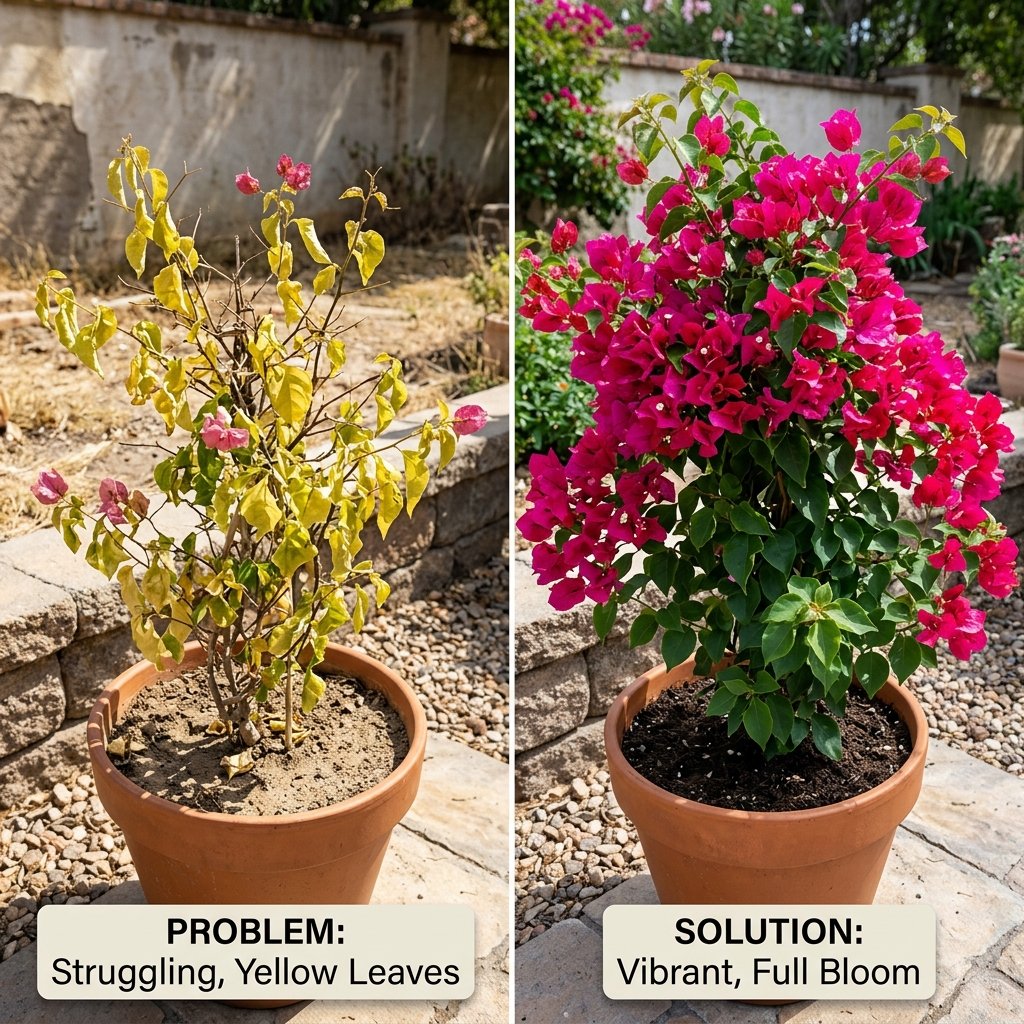
The most common bougainvillea problems in order of frequency: (1) Overwatering and root rot — check if soil stays wet for days; (2) No blooms — usually insufficient sun or too much nitrogen fertilizer; (3) Yellow leaves — overwatering, nutrient deficiency, or root rot; (4) Leaf drop — environmental stress from watering, light change, or pests. Start every diagnosis by checking root zone moisture first.
How to Diagnose Any Bougainvillea Problem (Start Here)
Before jumping to a solution, do these three checks in order — they identify the root cause of 80% of bougainvillea problems:
- Soil moisture check: Insert your finger 5cm into the soil. Wet and cool = overwatering problem. Bone dry and pulling away from pot edges = underwatering. Slightly moist = correct.
- Root inspection: Gently tip the plant out of its pot. Healthy roots are firm, cream/tan coloured. Black, mushy, or foul-smelling roots = root rot. Act immediately.
- Sunlight measurement: Honestly count hours of direct sun the plant receives. Less than 5 hours = bloom failure. Less than 3 hours = decline.
With these three checks, you can diagnose most problems in under 5 minutes. The sections below give you the fix for each.
Problem 1: Root Rot
Symptoms
Wilting despite wet soil, yellow or brown leaves falling rapidly, soft stems near the soil line, foul smell from the pot, black or brown mushy roots visible when removed from the pot.
Cause
Waterlogged soil prevents oxygen from reaching roots. Anaerobic conditions allow pathogenic fungi (Pythium, Phytophthora) to colonise and rot the root tissue. In India, this most often occurs during the monsoon season when poor drainage keeps soil wet for days at a time.
Fix — Act Within 24 Hours
- Remove the plant from its pot immediately. Wash all soil from the roots under clean water.
- Using sterilised scissors or pruners, cut away all rotten roots (black, mushy, or smelling). Cut back to healthy white/cream tissue.
- Dip the remaining healthy roots in a solution of 1 part 3% hydrogen peroxide to 3 parts water for 5 minutes. This kills residual fungal spores.
- Allow roots to air dry in shade for 30 minutes.
- Repot in fresh, fast-draining mix (60% potting soil + 40% perlite or coarse sand). Use a pot with clean, clear drainage holes — mesh them with plastic bonsai mesh to prevent clogging.
- Water lightly once, then do not water again for 5–7 days.
- Keep in bright shade (no direct sun) for 10–14 days during recovery. Then gradually resume full sun.
- Do not fertilize for 6 weeks.
Recovery timeline: If more than 50% of roots survived, expect new growth in 3–4 weeks. If less than 50% survived, recovery takes 6–10 weeks and is not guaranteed.
Problem 2: No Blooms
Symptoms
Plant is green and growing well, but produces no bracts for months despite appearing healthy.
Cause (in order of likelihood)
- Insufficient direct sunlight (less than 5–6 hours daily)
- Too much nitrogen fertilizer (lawn fertilizer, urea, or 19:19:19 used as main feed)
- Constant soil moisture — no drought stress period
- Plant too young (less than 1 year old)
- Recent hard pruning — new wood needs 2–3 months to mature before it blooms
Fix
Address in this order: (1) Move to full sun location. (2) Flush soil with 3x pot volume of water to leach nitrogen. (3) Switch fertilizer to bone meal or 5-30-5. (4) Begin the drought stress cycle — water only when the plant shows morning droop. Expect bract response in 4–8 weeks.
Recovery timeline: 4–8 weeks from sun and stress corrections.
Problem 3: Yellow Leaves
Symptoms and Diagnosis Table
| Pattern of Yellowing | Most Likely Cause | Fix |
|---|---|---|
| Older leaves yellow and fall, soil stays wet for days | Overwatering / root suffocation | Stop watering; improve drainage; check for root rot |
| Uniform yellowing across all leaves | Root rot (advanced) or nitrogen deficiency | Inspect roots; if clean, apply half-strength balanced fertilizer once |
| Yellow between veins, veins stay green (older leaves) | Magnesium deficiency | 1 tbsp Epsom salt per gallon of water, apply monthly for 2 months |
| Yellow between veins on new leaves | Iron deficiency (chlorosis) — often from alkaline soil | Foliar spray with chelated iron; check and correct soil pH to 6.0–6.5 |
| Yellow patches with dry edges on upper leaves | Sunburn (if recently moved to full sun) | Acclimate gradually over 10–14 days; do not remove affected leaves immediately |
Problem 4: Leggy Growth (Long Stems, Few Leaves)
Symptoms
Long, stretched stems with widely spaced leaves. Plant reaching toward light. Few branches. No blooms.
Cause
Insufficient sunlight is the primary cause. The plant extends its shoots in search of more light — a process called etiolation. Secondary cause: too much nitrogen fertilizer producing rapid but structurally weak growth.
Fix
(1) Move to a brighter location immediately. (2) Prune the leggy stems back by 50% — this removes the long, unproductive tissue and stimulates branching from lower nodes. (3) After pruning, do not fertilize for 4 weeks — let the plant redirect energy into compact new growth. (4) Provide 6+ hours of direct sun from this point forward.
Recovery timeline: Compact new growth appears in 3–5 weeks. Blooms follow 6–10 weeks after compact growth matures.
Problem 5: Powdery Mildew
Symptoms
White or grey powdery coating on leaves and young stems. Affected leaves may curl, yellow, and drop. Most common in Kolkata and West Bengal during October–November when humidity is high but rain has stopped.
Fix
Mix 1 teaspoon baking soda + 1 teaspoon neem oil + a few drops of liquid soap per litre of water. Spray every 5–7 days for 3–4 applications, covering both leaf surfaces. Improve airflow around the plant by thinning dense branches. Avoid overhead watering. In severe cases, use a systemic fungicide (propiconazole at label strength).
Prevention: Apply preventative neem spray every 14 days from mid-September when Bengal's humidity starts rising post-monsoon.
Problem 6: Bougainvillea Loopers (Chewed Leaves)
Symptoms
Leaves with scalloped or completely eaten edges. No visible insect during daytime. Damage appears overnight. Lime-green caterpillars found on undersides of leaves when inspected with a torch after dark.
Fix
Apply neem oil spray (5ml cold-pressed neem oil + 2.5ml liquid soap per litre of water) in the late evening, coating leaf undersides thoroughly. Repeat every 5–7 days for 3 applications. Alternatively, use Bacillus thuringiensis (Bt) biological insecticide — completely safe for humans, pets, and beneficial insects, highly effective against caterpillars. Hand-pick caterpillars at night for immediate reduction.
Problem 7: Leaf Drop (Without Yellow Leaves)
Symptoms
Green leaves dropping suddenly without yellowing first. Can be alarming but is often not fatal.
Cause and Fix
- Sudden relocation: Moving from indoor to outdoor or changing sun exposure causes shock. The fix is to stop moving the plant and give it 2–3 weeks to readjust. Do not water more, do not fertilize.
- Temperature shock: Cold nights below 10°C (common in North India in December–January). Move indoors or provide frost protection.
- November semi-dormancy in Bengal: Normal seasonal response to day length change. The plant is preparing for the cool winter — leaf drop stops within 2 weeks and is followed by the February bloom flush.
Problem 8: Overwatering (Without Visible Root Rot Yet)
Symptoms
Soil stays wet for 4+ days after watering. Leaves feel slightly soft. New growth looks pale. No blooms. Occasional yellowing of lower leaves.
Fix
Stop watering immediately. Tip the pot to one side to allow excess water to drain. Create airflow around the pot by lifting it off the ground. Do not water again until the top 5cm of soil is completely dry. If the soil remains wet for more than 6 days without rain, consider repotting into a faster-draining mix before root rot develops.
Most bougainvillea problems come down to two things: too much water and too little sun. Fix both and the plant's natural resilience does the rest.
Recommended next actions
Next Best Actions
Move from reading to action with related calculators, plant profiles, and quiz-based recommendations.
Calculator
Bougainvillea Potting Mix Calculator
Calculate the exact volumes of perlite, compost, and soil for a fast-draining Bougainvillea mix.
Calculator
Bougainvillea Grow Bag Size Calculator
Calculate the ideal fabric grow bag volume for massive Bougainvillea growth.
Calculator
Bougainvillea Neem Oil & Pest Calculator
Calculate precise neem oil dilutions to eradicate Bougainvillea Loopers and aphids.
Plant Guide
'Adarna' (Shikendari)
Bougainvillea 'Adarna' (Shikendari) is a rare collector's cultivar prized for its spectacular multicoloured bracts that shift between yellow, orange, and deep pink-magenta. A prolific bloomer for hot, full-sun gardens, fences, and large containers across tropical India.
Plant Guide
'Barbara Karst'
Bougainvillea 'Barbara Karst' is a vigorous, popular cultivar prized for its brilliant magenta-red bracts and prolific, nearly year-round blooming habit. One of the hardiest bougainvilleas, it thrives in hot, full-sun gardens, on fences and trellises, and in large containers across tropical and subtropical climates.
Plant Guide
'California Gold'
Bougainvillea 'California Gold' is a vigorous and popular cultivar prized for its stunning, warm golden-yellow bracts that sometimes shift to a bronze-orange as they age. A prolific bloomer for hot, full-sun gardens, fences, trellises, and containers across tropical and subtropical climates.