Best Fertilizer for Bougainvillea in 2026 — NPK Ratios That...
A no-nonsense 2026 guide to bougainvillea fertilization: the NPK ratios that actually produce bracts (not just leaves), what Indian-market products to use, what to avoid, and a season-by-season feeding calendar tested in West Bengal.
Quick Answer
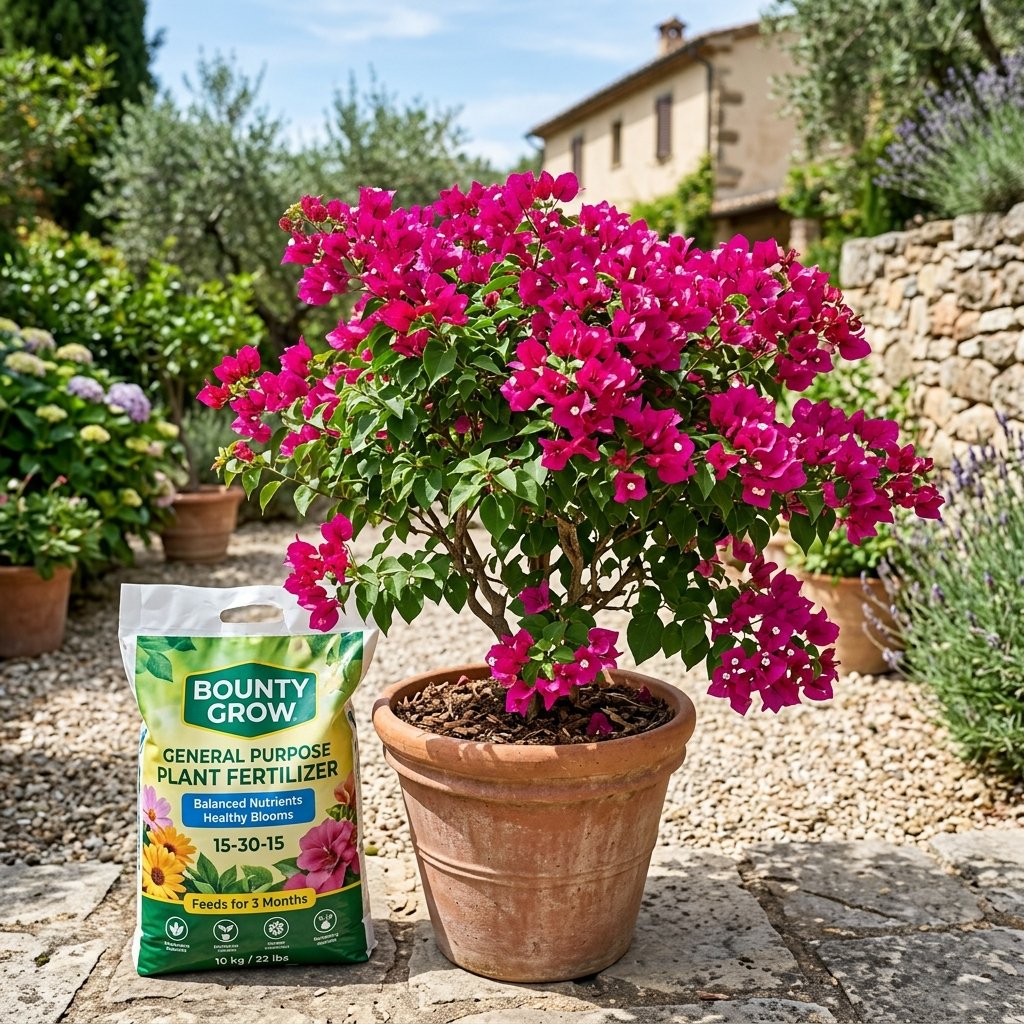
The best fertilizer for bougainvillea has a low first number (nitrogen) and high second and third numbers (phosphorus and potassium). Target ratios: 5-30-5, 2-10-10, 0-10-10, or 3-12-12. In the Indian market this means: bone meal, DAP diluted heavily, or any labelled bloom booster with N below 10. Avoid any fertilizer with nitrogen above 10 (including 19:19:19 used as a primary feed) — it grows leaves, not bracts.
Why Most Bougainvillea Fertilizer Advice Gets It Wrong
The most common fertilizer mistake — and the one we see almost every day at our nursery — is using high-nitrogen plant food on a bougainvillea and then wondering why it refuses to bloom. The plant grows beautifully: big, glossy, deep-green leaves, long vigorous shoots. But not a single bract.
This happens because nitrogen is the element that drives vegetative (leaf and stem) growth. Phosphorus and potassium drive root development and flowering. When you feed a bougainvillea more nitrogen than it needs, you are essentially telling it to keep growing leaves. It listens.
The 2026 update to this advice: the Indian agricultural market is now flooded with water-soluble fertilizers that promise blooms but deliver mostly leaf growth. This guide cuts through the noise and tells you exactly what to buy, what to avoid, and when to apply it — based on testing in West Bengal conditions.
The NPK Numbers: What They Mean for Bougainvillea
Every fertilizer bag has three numbers: N-P-K (Nitrogen-Phosphorus-Potassium). For bougainvillea:
- N (first number): Keep this LOW. Below 10, ideally below 5. Nitrogen grows leaves and stems.
- P (second number): Keep this HIGH. Phosphorus supports root development and bract (flower) production. This is your bloom trigger.
- K (third number): Keep this MEDIUM to HIGH. Potassium improves stress tolerance, bloom intensity, and colour.
| Fertilizer Ratio | Good for Bougainvillea? | When to Use | India Availability |
|---|---|---|---|
| 0-52-34 (MKP) | Excellent — pure bloom trigger | Pre-bloom and peak bloom (dilute to quarter label strength) | Available at agricultural suppliers as Monopotassium Phosphate |
| 5-30-5 | Excellent | Pre-bloom phase | Some branded bloom boosters; also mix DAP + potassium sulfate |
| DAP (18:46:0) | Good if heavily diluted | Single dose in early bloom season only | Widely available at kisan / agriculture shops nationwide |
| Bone meal (3-15-0) | Good for slow P release | Mix into soil at repotting or top-dress monthly | Available at most nurseries and garden centres |
| 19:19:19 (balanced) | Only in spring wake-up | Single dose after winter dormancy only | Widely available as water-soluble crystal |
| Urea (46:0:0) | Avoid entirely | Never during bloom season | Very common — this is what kills bloom |
| Lawn fertilizer (30:10:10) | Avoid entirely | Never | Often sold as general-purpose plant food — read the label |
Organic Options That Work in India
If you prefer organic inputs — and in West Bengal's climate, organic fertilizers often outperform synthetic ones in the long run because they improve soil structure — here are the most effective options:
Bone Meal (3-15-0)
The single best organic phosphorus source for bougainvillea. Work 1–2 tablespoons per 30cm pot into the top 5cm of soil every 6–8 weeks during the growing season. It releases slowly, so it will not burn roots and does not wash out immediately in rain. Available at most nurseries and many online garden stores for ₹80–150 per kg.
Mustard Cake (Sarson Ki Khali)
A balanced slow-release organic fertilizer commonly available in Bengal and Bihar markets. NPK is roughly 5:2:1 — moderate nitrogen, decent phosphorus. Ferment it in water for 48 hours (1 tablespoon per litre) before applying, or it will cause ammonia burn. Good for the early growing season but not ideal for peak bloom — switch to bone meal and potassium sulfate as bract season approaches.
Banana Peel Compost Tea
High in potassium and micronutrients. Soak 3–4 banana peels in 2 litres of water for 48 hours, then dilute 1:5 with water before applying. Use monthly during the growing season. Not a complete fertilizer — combine with bone meal for P, and it becomes a surprisingly effective organic bloom combination.
Vermicompost
Excellent soil amendment. Top-dress pots with 1–2cm of vermicompost monthly. It improves drainage in heavy clay soils (critical in Bengal), feeds beneficial microbes, and provides a full nutrient profile at safe, slow-release levels. Use as the base layer in potting mix and refresh annually at repotting.
Seasonal Feeding Calendar for West Bengal
| Month | Bengal Season | Fertilizer Action | Reason |
|---|---|---|---|
| January–February | Cool dry season | One dose balanced 19:19:19 at half strength, then switch to bone meal | Wake up from winter slow-down; support the February bloom flush |
| March–April | Pre-summer | Bone meal monthly + potassium sulfate | Pre-bloom nutrition before peak heat |
| May | Pre-monsoon heat | Reduce to half dose; skip if plant is heat-stressed | High heat reduces nutrient uptake; risk of salt burn |
| June–September | Active monsoon | Pause fertilizing entirely | Waterlogged soil = no uptake; nutrients wash away or cause burn |
| October | Post-monsoon recovery | Single dose DAP (heavily diluted) or MKP at quarter strength | Phosphorus boost triggers October bloom flush |
| November–December | Post-bloom cool-down | Light balanced feed (19:19:19 at quarter strength) once | Support recovery after bloom; prepare for winter |
How to Apply: The Practical Details
Always Water Before Fertilizing
Never apply fertilizer to dry soil. Water the plant thoroughly 30 minutes before feeding. This prevents root burn from concentrated nutrients hitting dry root tissue.
Use Half or Quarter Label Strength for Pots
Pots have limited soil volume and limited drainage pathways. Fertilizer salts accumulate quickly. Use half the label-recommended dose for any fertilizer applied to a potted bougainvillea. If the label says 5ml/litre, use 2.5ml/litre.
Flush Pots Every 3 Months
Even with careful feeding, salt accumulates in pot soil over time. Every 3 months, water the pot until 3 times the pot's volume of water has passed through it. This flushes excess salts out through the drainage holes. Do this in the morning and allow the pot to drain completely before evening.
Signs You Are Over-Fertilizing
- White crust appearing on soil surface or pot rim (salt accumulation)
- Leaf tips turning brown and crispy without underwatering as a cause
- Rapid vegetative growth with zero bracts despite full sun
- Sudden leaf drop after feeding
What We Tested in 2025–26 (West Bengal Conditions)
Over the 2025–26 growing season, we ran informal comparison trials on 5 Barbara Karst plants in identical 30cm terracotta pots, same potting mix, same sunlight exposure. The five treatments were: (1) No fertilizer at all, (2) Urea monthly, (3) 19:19:19 monthly, (4) Bone meal + potassium sulfate monthly, and (5) MKP (0-52-34) at quarter strength pre-bloom then bone meal maintenance.
Results: Treatment 5 produced the heaviest and earliest bract set (mid-October), followed closely by Treatment 4. Treatment 2 (urea) produced the most leaves and zero bracts through November. Treatment 3 produced moderate bracts only in February. Treatment 1 (unfed) produced a moderate October flush — demonstrating that withholding fertilizer is often better than using the wrong fertilizer.
The best fertilizer for bougainvillea is the right one at the right time. The wrong fertilizer — even an expensive one — will give you a beautiful green plant with no colour.
Recommended next actions
Next Best Actions
Move from reading to action with related calculators, plant profiles, and quiz-based recommendations.
Plant Guide
Chitra India
This Chitra India bougainvillea is valued for its bright pink to magenta bracts and its vigorous climber with strong repeat bloom. In warm tropical and subtropical gardens, it performs as a resilient ornamental climber that rewards full sun, sharp drainage, and a restrained feeding regime with long flushes of colour.
Plant Guide
21 Jewel Pink
This 21 Jewel Pink bougainvillea is valued for its pink to deep rose bracts and its floriferous climber with reliable warm-season colour. In warm tropical and subtropical gardens, it performs as a resilient ornamental climber that rewards full sun, sharp drainage, and a restrained feeding regime with long flushes of colour.
Plant Guide
21 Jewel Pink Variegated
This 21 Jewel Pink Variegated bougainvillea is valued for its pink with cream or white variegation bracts and its floriferous climber with reliable warm-season colour. In warm tropical and subtropical gardens, it performs as a resilient ornamental climber that rewards full sun, sharp drainage, and a restrained feeding regime with long flushes of colour.
Calculator
Bougainvillea NPK Fertilizer Calculator
Analyze your fertilizer NPK ratio to ensure it promotes Bougainvillea blooms rather than just green leaves.
Calculator
Bougainvillea Potting Mix Calculator
Calculate the exact volumes of perlite, compost, and soil for a fast-draining Bougainvillea mix.
Calculator
Bougainvillea Grow Bag Size Calculator
Calculate the ideal fabric grow bag volume for massive Bougainvillea growth.