Bougainvillea 'Mary Palmer'
Bougainvillea (Spectoperuviana Group) 'Mary Palmer'
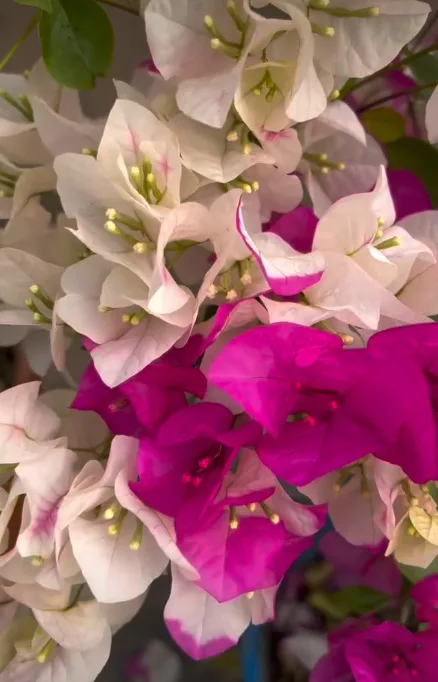
Bougainvillea 'Mary Palmer' is a unique bicolor cultivar prized for its fascinating bracts that open coppery pink and fade to soft white or cream. A vigorous climber for hot, full-sun gardens, fences, trellises, and containers across tropical climates.
-
Light
Full, direct sunlight is mandatory for 'Mary Palmer' to produce its characteristic bicolor bracts. Insufficient light leads to lush green growth but few to no flowers. The stunning transformation from coppery pink to white is best expressed in full sun.
-
Temperature
65°F – 95°F (18°C – 35°C)
Growth
fast
pH Range
6.0 – 7.0
-
Biggest Owner Mistake
Overwatering is the single most common way to kill 'Mary Palmer'. Owners treat it like a thirsty tropical plant and water daily, which prevents the dry-stress trigger for blooming and rapidly causes root rot — especially in containers during the rainy season. The second biggest mistake is placing it in partial shade; without 6+ hours of direct sun, the unique bicolor transition from copper-pink to white becomes dull and less distinct.
-
What Nobody Tells You
Mary Palmer was raised as a bud sport from 'Mrs. H. C. Buck' in Calcutta in 1949, and it has since become the parent of other cultivars — 'Thimma' originated as a bud sport from 'Mary Palmer' at Lal Bagh, Bangalore in 1960. This means 'Mary Palmer' is not just a beautiful variety but also an important genetic bridge in bougainvillea breeding history. The colour change from copper-pink to white is one of the most fascinating displays in the bougainvillea world — no two blooms look exactly the same at the same time.
-
Real Home Conditions
The biggest seasonal threat is not heat or drought — it's overwatering during rainy or humid seasons when soil stays wet for days. Prolonged waterlogged soil is the number one killer of container 'Mary Palmer'. Elevate pots, ensure drainage holes are unobstructed, and move containers under a sheltered overhang during sustained heavy rain. Conversely, hot, dry summers are nearly ideal: the intense heat and deliberate water stress are exactly the conditions that push 'Mary Palmer' into its most spectacular bicolor bloom phase. In cooler climates (below 10°C / 50°F), bring containers indoors to a bright, frost-free spot and reduce watering significantly until temperatures rise again.
Quick Answer
Bougainvillea 'Mary Palmer' needs full direct sun (6–8 hours minimum), deep but infrequent watering with deliberate dry spells to trigger blooms, and excellent drainage. It rewards stress with its unique bracts that open copper-pink and fade to white.
Overview
Bougainvillea 'Mary Palmer' is a distinctive and sought-after bicolor cultivar, prized for its fascinating bracts that open in warm copper-pink tones and gradually mature to soft white or cream — creating a stunning multicolour effect on the same plant. Raised as a bud sport from 'Mrs. H. C. Buck' in Calcutta, India, by S. Peroy-Lencester in 1949, this vigorous scrambling woody shrub belongs to the Nyctaginaceae family and has become a favourite for tropical and subtropical gardens. 'Mary Palmer' typically reaches 4–8 metres in height with a spread of 2.5–4 metres, making it an excellent choice for covering fences, trellises, walls, and small garden structures. Its compact growth habit and adaptability to containers also make it popular for patios, balconies, and even bonsai training. Like all bougainvilleas, 'Mary Palmer' is fundamentally a 'bloom-on-stress' plant. It does not reward pampering. The key to triggering its most spectacular colour display is understanding how to balance sun, water stress, and lean fertilization. Overwater it in a shaded spot and it will produce a wall of lush green leaves and almost no bracts. Give it relentless direct sun, deliberately dry periods between deep waterings, and the occasional pruning, and it will reward you with its unique colour-changing display.
Light
Full, direct sunlight is non-negotiable. 'Mary Palmer' needs a minimum of 6 to 8 hours of unobstructed direct sun every single day. More is better. A south- or west-facing outdoor position is ideal. The intensity of its colour transformation is directly tied to sun exposure — plants in full sun produce the most vivid coppery pink tones and the cleanest white maturation, while those in partial shade will produce fewer blooms and the colour transition may appear washed out or incomplete. While it can be grown indoors, it requires a very bright location, such as a south-facing window, to thrive and bloom.
Temperature
'Mary Palmer' thrives in warm, humid conditions. It handles intense heat well (up to 40°C / 104°F) and actively blooms through summers. It is frost-sensitive and will die back or be killed by sustained temperatures below 10°C (50°F). It can tolerate brief dips to -1°C but should be protected from heavy frosts. In USDA zones 9-11, it can be treated as a permanent outdoor perennial with year-round growth.
Humidity
It tolerates a wide humidity range and handles high humidity well, provided the soil drainage is excellent. The danger period is the rainy season, when combined high humidity and waterlogged soil accelerates root rot. Elevate containers during heavy rain periods or move them under a sheltered overhang to manage excess water.
Watering: The Stress-Watering Method
This is the single most important technique for getting 'Mary Palmer' to bloom prolifically: water deeply, then allow the soil to dry out completely before watering again. Bougainvillea evolved in seasonally dry South American forests and uses dry periods as its biological trigger to shift energy from leaf production into flowering. In practice, check the top 1 to 2 inches of soil — only water when it is completely dry to the touch. Apply water slowly and deeply until it runs freely from the drainage holes, then stop and do not water again until the soil dries. For containers, never leave the pot sitting in a saucer of standing water. During active bloom cycles, extending the dry-down period further is a proven method to initiate a heavy new flush of bracts. Once established, 'Mary Palmer' is highly drought tolerant and requires very little supplemental irrigation.
Soil
Excellent drainage is the most important soil property. A mix of loamy garden soil, coarse river sand, and perlite works well for containers. Pre-made cactus or succulent mixes amended with some compost are also suitable. The ideal soil pH is slightly acidic to neutral, between 6.0 and 7.0. Avoid heavy, water-retentive soils. In-ground planting on slightly raised beds or slopes is ideal to prevent waterlogging.
Fertilizer
'Mary Palmer' is a heavy feeder during active growth. Use a balanced NPK fertilizer (10-10-10 or 20-20-20) every two to four weeks during spring and summer. When you want to trigger or intensify a bloom flush, switch to a high-phosphorus and high-potassium bloom booster formula (such as 10-30-20) and reduce nitrogen, as excess nitrogen directs energy into leafy growth at the expense of bracts. Always water the soil before applying fertilizer to avoid root burn. Organic options include compost tea, well-rotted cow manure, and banana peel water for potassium supplementation.
Pruning
Bougainvillea bracts form on new lateral shoots that emerge from mature canes, not on old woody growth. Regular pruning is therefore directly tied to bloom production. After each bloom flush fades, tip-prune the lateral shoots to just above a leaf node. This stimulates branching and the development of multiple new flowering shoots. For a trellis or fence application, train 4 to 6 main framework canes horizontally or diagonally — horizontally-trained canes produce far more laterals (and therefore more blooms) than vertical ones. A harder structural prune can be performed in early spring before the main growing season begins. Always wear thick gloves; thorns are sharp, and the sap is a skin irritant.
Propagation
Propagate from semi-hardwood stem cuttings taken from pencil-thick stems with 4 to 6 leaves. Cut just below a leaf node to a length of 4 to 6 inches, strip the lower leaves, and dip the cut end in rooting hormone powder. Insert into a fast-draining propagation mix of perlite and peat. Keep barely moist — never wet — in a warm spot with bright indirect light. Roots typically develop in 4 to 8 weeks. Alternatively, propagate through layering by bending a low branch to the ground and covering a section with soil. As a cultivated variety, be aware that it may be subject to certain restrictions or prohibitions on propagation.
Toxicity
Bougainvillea sap can cause contact dermatitis — skin redness, itching, and rash — on direct contact in sensitive individuals. The plant is considered poisonous and should be kept away from pets and children. Always wear gloves when pruning.
Common Problems
The most frequent problem is root rot from overwatering or poor drainage, especially during rainy seasons. If the plant collapses, check the roots — brown, mushy roots confirm rot; cut back to healthy tissue and repot in fresh, dry, well-draining mix. Yellowing leaves between the veins (interveinal chlorosis) typically indicates iron deficiency, common in alkaline soils — treat with iron chelate or a micronutrient feed. Lush green growth with no bracts almost always means either too little sunlight or too much nitrogen fertilizer. Aphids, mealybugs, and spider mites are the most common pest threats; treat promptly with neem oil spray.
Recommended next actions
Next Best Actions
Use calculators and guides to turn this plant profile into a practical care routine.
Calculator
Bougainvillea Watering Schedule Calculator
Calculate exactly when to water your Bougainvillea using the proven Dry-to-Bloom method.
Guide
Bougainvillea Growing Guide: Sun, Soil, Pruning, and Climate
Complete bougainvillea growing guide for tropical, subtropical, and Mediterranean climates. Learn sunlight, soil mix, pruning, and seasonal care for dwarf balcony pots to large wall climbers.
Guide
Why Every Gardener Should Have the Arjuna Bougainvillea (Complete Variety Guide)
The Arjuna Bougainvillea is a near-year-round bloomer prized for its vivid multi-color flowers, disease resistance, and beginner-friendly nature. Here's why it earns a spot in every garden, plus a full care guide.
Guide
Bougainvillea Bonsai: Complete Beginner's Guide to Growing, Styling, and Caring
Bougainvillea makes a spectacular bonsai — fast-growing, drought-tolerant, and capable of producing vivid bracts even in a tiny pot. This guide covers species selection, soil, root pruning, wire training, and seasonal care for Indian conditions.
Calculator
Bougainvillea Heat Stress & Watering Calculator
Diagnose heat stress in potted Bougainvilleas during extreme summer weather.
Calculator
Bougainvillea Potting Mix Calculator
Calculate the exact volumes of perlite, compost, and soil for a fast-draining Bougainvillea mix.
Structured Plant Data
Plant Data Profile
Care values below are generated from the plant JSON fields so users and crawlers can read the structured plant profile directly on the page.
Growth Characteristics
Growth Rate
fast
Mature Height
4–8 metres (13–26 feet) depending on support; manageable in containers
Mature Spread
2.5–4 metres (8–13 feet)
Life Cycle
Perennial (evergreen in frost-free tropical climates)
Flowering Season
Long blooming period, primarily spring and summer
Container Friendly
yes
Indoor Capable
yes, with sufficient light
Environmental Parameters
| Parameter | Recommended | Survivable |
|---|---|---|
| Temperature | 65°F – 95°F (18°C – 35°C) | 50°F – 105°F (10°C – 40°C) |
| Humidity | 40% – 70% | 30% – 85% |
| Soil PH | 6.0 – 7.0 | 5.5 – 7.5 |
Lighting
Description
Full, direct sunlight is mandatory for 'Mary Palmer' to produce its characteristic bicolor bracts. Insufficient light leads to lush green growth but few to no flowers. The stunning transformation from coppery pink to white is best expressed in full sun.
Nutrients
Nitrogen Demand
moderate
Phosphate Demand
high
Potassium Demand
high
Micronutrient Notes
Benefits from iron and magnesium supplementation, particularly in alkaline soils where interveinal chlorosis (yellowing between leaf veins) is common.
Fertilizer Frequency
Every 2–4 weeks during active growth (spring and summer). Use a balanced NPK (10-10-10 or 20-20-20) for general growth, or switch to a high-phosphorus and high-potassium bloom booster formula (e.g. 10-30-20) to trigger bloom flushes. Reduce to once a month or stop entirely during cool rest periods. Avoid high-nitrogen fertilizers which promote leaves over flowers.
Organic Options
Compost tea, well-rotted cow manure, banana peel water (for potassium), and bone meal (for phosphorus) are effective organic supplements.
Relationships
-
Root Rot
Vulnerability | High vulnerability
Highly susceptible to root rot in waterlogged or poorly draining soil. This is the primary cause of death, especially during rainy seasons.
-
Aphids
Vulnerability | Moderate vulnerability
Soft new growth attracts aphids, particularly when the plant receives excess nitrogen fertilizer. Treat with neem oil spray or insecticidal soap.
-
Mealybugs
Vulnerability | Moderate vulnerability
Mealybugs colonise stem joints and the undersides of leaves. Wipe off with isopropyl alcohol on a cotton swab or apply neem oil.
-
Spider Mites
Vulnerability | Moderate vulnerability
Spider mites appear in hot, dry, dusty conditions. Improve air circulation and treat with a miticide or neem oil spray.
Mary Palmer vs Other Popular Bougainvillea Cultivars
| Cultivar | Bract Color | Foliage | Growth Habit | Special Feature |
|---|---|---|---|---|
| Mary Palmer | Copper-pink aging to white | Light green, sometimes copper-tinged new growth | Vigorous climber 4–8 m | Bicolor, bud sport of 'Mrs. H. C. Buck' |
| Barbara Karst | Bright magenta-red | Dull dark green | Vigorous climber 20–40 ft | One of the hardiest varieties |
| Elizabeth Angus | Deep purple to magenta | Glossy, dark green | Vigorous climber 6–30 ft | Deep purple bracts |
| California Gold | Golden-yellow to bronze-orange | Dark green, glossy | Vigorous climber 15–30 ft | Golden blooms |
Growing Position
Placement Notes
Pink and white bougainvilleas are associated with the water element, which balances the fire energy of the South direction. They promote calmness, peace, harmony, prosperity, and abundance. The thorny stems act as a protective boundary plant. Avoid planting directly at the main entrance.
Best Directions
South Or West Boundary; Pink/White Varieties Are Beneficial In The South Direction
Best Rooms
Outdoor position
Light Range
Full sun
Care Profile
Outdoor flowering vine
Troubleshooting Guide
1 Lush green growth but no colored bracts
Cause: Insufficient direct sunlight, excess nitrogen fertilizer, or overwatering preventing the dry-stress trigger that initiates flowering.
Move to a full-sun position with 6–8 hours of direct sun. Withhold watering for 3–4 weeks to stress-trigger blooming. Switch from a nitrogen-heavy feed to a high-potassium / high-phosphorus formula.
2 Leaves turning yellow between the veins (interveinal chlorosis)
Cause: Iron deficiency, often induced by alkaline soil that locks out micronutrients.
Apply an iron chelate solution or a micronutrient feed. Acidify the soil slightly with sulfur or use acidified water.
3 Stem base and roots turning brown and mushy
Cause: Root rot caused by overwatering or waterlogged soil, particularly common during rainy seasons.
Immediately remove the plant from the wet soil. Cut all mushy roots back to healthy tissue. Repot in a fresh, well-draining dry mix and withhold water until the plant stabilizes.
4 Bracts are all white or all pink, not showing the characteristic bicolor transition
Cause: Insufficient sunlight or natural variation; this cultivar may sometimes produce solid-colored bracts.
Maximise direct sun exposure. Some reversion is normal. Prune back solid-colored shoots to encourage variegated growth.
Glossary of Terms
- Bracts
- The large, papery, colourful modified leaves of a bougainvillea that are commonly mistaken for flowers. The actual flowers are the small, tubular white structures held at the centre of each bract cluster.
- Bud Sport
- A mutation occurring on a single bud that gives rise to a branch with different characteristics from the parent plant. 'Mary Palmer' originated as a bud sport from 'Mrs. H. C. Buck'.
- Stress-Watering
- A deliberate watering technique for bougainvillea where the plant is watered deeply and then allowed to dry out completely — sometimes for several weeks — to mimic a dry season. This dry-stress period is the primary trigger for bract production.
- Interveinal Chlorosis
- A condition where leaves turn yellow but the veins remain green, often indicating a nutrient deficiency such as iron or magnesium. Common in bougainvilleas grown in alkaline soils.
Scientific References
- Bougainvillea (Spectoperuviana Group) 'Mary Palmer'
- Bougainvillea 'Penelope' | bougainvillea 'Mary Palmer's Enchantment'
- Ultimate Guide to Bougainvillea 'Mary Palmer's Enchantment'
- Bougainvillea Mary Palmer
- Mary Palmer's Enchantment Bougainvillea