Bougainvillea 'Maharani'
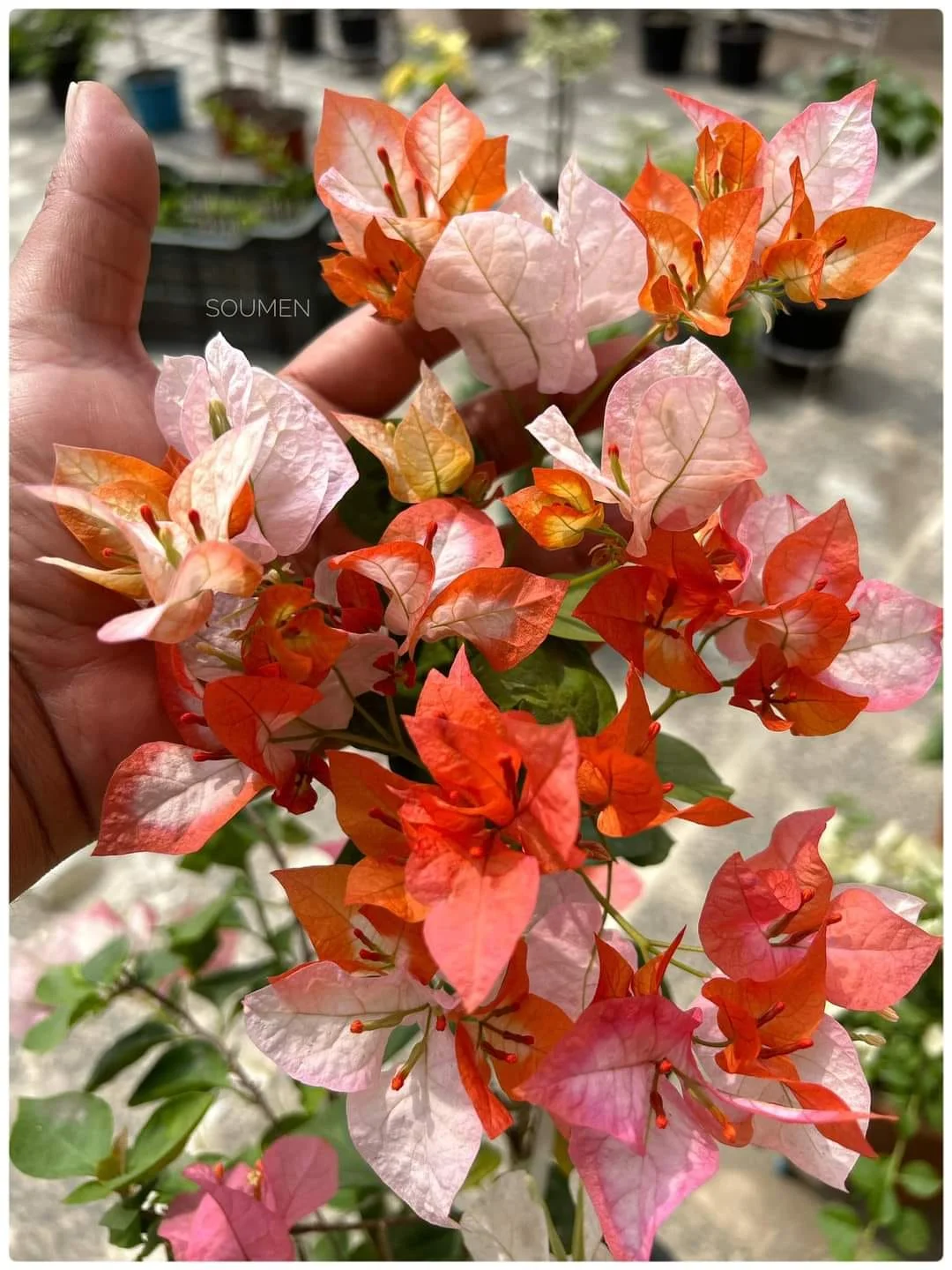
A rare, non-seeding repeat bloomer featuring sunset-like dual-colour orange and cream bracts on a compact, collector-grade vine.
-
Light
Bright indirect
-
Temperature
18-25°C (64-77°F)
Growth
Moderate; slower than vigorous B. spectabilis types
pH Range
General
-
Expert Insight
Master-grower data coming soon.
-
Common Mistake
Real-world care data coming soon.
-
Environment
Real-world conditions coming soon.
Quick Answer
'Maharani' bougainvillea performs best in full sun, lean soil, and very sharp drainage to keep flowering vigorous and the bracts bright. Water deeply only when the top 5–7 cm dries out, use a low-nitrogen fertiliser, and prune lightly after each bloom flush.
Overview
Bougainvillea 'Maharani' is a rare, non-seeding repeat-blooming cultivar with sunset-like orange and cream bracts and a compact medium-vine to bush habit. Reported to have emerged from China in the late 2010s as a stable mutation of the 'Miss Manila' lineage, it has become especially attractive to collectors who want intense colour without sacrificing floral density.
If you are researching how to grow Maharani bougainvillea, treat it as a heat-loving ornamental that performs best in full direct sun, strong air movement, and a very free-draining root zone. It is well suited to containers, balconies, and bright landscape positions where its dense flushes can be shown off at close range.
The most effective growing secret is to avoid overfeeding, because excess nitrogen encourages soft growth instead of the tight bloom cycles this cultivar is known for. Keep watering deep but infrequent, let the mix dry slightly between irrigations, and prune lightly after flowering to maintain a compact framework and repeated bract display.
Quick Answer
'Maharani' bougainvillea performs best in full sun, lean soil, and very sharp drainage to keep flowering vigorous and the bracts bright. Water deeply only when the top 5–7 cm of soil feels dry, feed with a low-nitrogen, high-phosphorus fertiliser during active bloom cycles, and prune lightly after each flush to maintain shape and stimulate new wood.
Origin & Lineage
'Maharani' first appeared in Chinese nurseries around 2016–2018 as a spontaneous, stable mutation derived from the widely grown 'Miss Manila' lineage. Unlike its parent, which produces viable seed and can self-sow aggressively in tropical climates, 'Maharani' is effectively non-seeding. This makes it ideal for gardeners who want the tropical look without the invasive spread.
The name "Maharani" — meaning "queen" in Sanskrit/Hindi — reflects the cultivar's regal bicolour display. Its bracts open in warm apricot-orange tones and mature to a creamy ivory, often holding both colours simultaneously on the same truss for a striking sunset gradient.
Bract Colour & Bloom Behaviour
What makes 'Maharani' stand out in any bougainvillea collection is the dual-colour transition:
- New bracts: Warm orange with a faint coral-pink undertone.
- Mature bracts: Fade to soft cream and ivory.
- True flowers: Tiny white tubular blooms clustered at the centre of each bract truss.
Because the colour shift is gradual, a single plant in full flush can display a full ombré spectrum from deep orange to pale cream. Bloom cycles are repeat and reliable in warm conditions, typically peaking in late spring, mid-summer, and early autumn.
Care Requirements
Light
Full direct sun is absolutely non-negotiable. 'Maharani' needs a minimum of 6 hours of unfiltered sunlight daily; 8–10 hours is ideal. In partial shade, the plant will remain healthy but produce far fewer bracts and the colour intensity will be noticeably muted. South-facing balconies, open courtyards, and unshaded poolside beds are perfect placements.
Water
Deep, infrequent watering is the key to heavy blooming. Allow the top 5–7 cm of potting mix or garden soil to dry completely between irrigations. In containers, this usually means watering every 5–7 days in summer and every 10–14 days in cooler months. In the ground, established plants can survive on rainfall alone in humid subtropical climates.
Warning: Overwatering is the fastest way to get lush green leaves and zero flowers. It also predisposes the roots to rot in poorly drained mixes.
Soil & Drainage
'Maharani' thrives in a lean, gritty, fast-draining mix. A typical container blend should be:
- 40% high-quality potting compost
- 30% coarse perlite or pumice
- 20% fine bark or coco chips
- 10% coarse sand or grit
Garden soil should be amended with compost and grit if it is heavy clay. The pH should sit between 5.5 and 6.5 (slightly acidic). Bougainvillea is remarkably tolerant of poor, rocky soils — in fact, it often flowers more profusely when nutrients are scarce.
Temperature & Hardiness
As a tropical to subtropical cultivar, 'Maharani' is best grown in USDA zones 10–11. It can tolerate brief dips to 2–4°C, but sustained frost will damage tender new growth and bracts. In marginal zone 9b, it can survive with heavy winter mulching and a south-facing wall microclimate, but expect defoliation and slower spring recovery.
Optimal growing temperatures range from 18–32°C. Growth and flowering slow dramatically below 15°C.
Fertiliser
Feed with a low-nitrogen, high-phosphorus, high-potassium formulation (e.g., NPK 5-10-10 or 6-12-12) every 4–6 weeks during the active growing season. Avoid high-nitrogen lawn fertilisers or balanced 20-20-20 blends, which will produce long, leafy shoots at the expense of colour.
A monthly foliar spray of liquid seaweed or micronutrient mix can improve bract longevity and leaf gloss, but it is not essential.
Pruning
Prune after each major bloom flush rather than on a calendar date. This cultivar flowers on new wood, so removing 15–25% of the previous growth immediately after bracts drop will force fresh lateral shoots and the next wave of colour.
Because 'Maharani' has a naturally compact, semi-dwarf habit, it does not require aggressive renovation pruning. Light tip-pruning and removal of inward-crossing branches are usually sufficient to maintain a dense, rounded bush or a neat espalier.
Growth Characteristics
- Habit: Compact medium vine to bushy shrub; can be trained as a standard, espalier, or cascading container specimen.
- Mature height: 1.5–2.5 m in containers; 3–4 m if allowed to climb unrestricted in the ground.
- Spread: 1.2–2.0 m depending on pruning regime.
- Growth rate: Moderate; slower than vigorous species like B. spectabilis, which makes it easier to maintain in small spaces.
- Thorns: Present but relatively sparse compared to wild-type bougainvillea; still wear gloves when pruning.
- Leaf: Medium green, ovate, slightly glossy, 4–6 cm long.
Common Problems
No Flowers
The most common complaint. Causes include too much shade, too much water, too much nitrogen, or pruning at the wrong time. Review the light and water rules above before reaching for supplements.
Leaf Drop
Can occur after a sudden cold snap, transplant shock, or a drastic change in watering routine. 'Maharani' usually recovers quickly if warmth and proper drainage are restored.
Pests
Generally pest-resistant. Aphids may cluster on soft new growth in spring; a sharp jet of water or insecticidal soap handles them easily. Root rot only appears in waterlogged, compacted soils.
Landscape & Design Uses
Thanks to its compact frame and non-seeding habit, 'Maharani' is exceptionally versatile:
- Container specimen: Ideal for balconies, patios, and rooftop gardens where space is limited.
- Standard topiary: Train a single trunk with a rounded head for a formal entrance or poolside accent.
- Espalier: Flatten against a warm wall to maximise reflected heat and display the bicolour bracts.
- Mixed tropical border: Combine with silver-leaved plants (e.g., Stachys byzantina) or deep green foliage for contrast.
- Hanging basket: Young plants can be allowed to weep over the rim for a cascade of sunset tones.
Why Collectors Choose 'Maharani'
Between its stable genetics, repeat-bloom reliability, restrained size, and genuinely unique colour palette, 'Maharani' has earned a place in serious bougainvillea collections worldwide. It offers the visual impact of a large tropical vine without the maintenance burden or invasive risk of older, seeding cultivars. For gardeners in warm climates who want a conversation piece that flowers for months with minimal intervention, this queen lives up to her name.
Recommended next actions
Next Best Actions
Use calculators and guides to turn this plant profile into a practical care routine.
Guide
Bougainvillea Growing Guide: Sun, Soil, Pruning, and Climate
Complete bougainvillea growing guide for tropical, subtropical, and Mediterranean climates. Learn sunlight, soil mix, pruning, and seasonal care for dwarf balcony pots to large wall climbers.
Guide
Bougainvillea Bonsai: Complete Beginner's Guide to Growing, Styling, and Caring
Bougainvillea makes a spectacular bonsai — fast-growing, drought-tolerant, and capable of producing vivid bracts even in a tiny pot. This guide covers species selection, soil, root pruning, wire training, and seasonal care for Indian conditions.
Guide
The Ultimate Guide to Growing Bougainvillea in Pots
Bougainvillea can thrive in pots when its roots are kept slightly constrained, its drainage is excellent, and its care is adjusted through summer, winter, and monsoon. This guide shows you how to keep it blooming heavily in containers all year long.
Calculator
Bougainvillea Heat Stress & Watering Calculator
Diagnose heat stress in potted Bougainvilleas during extreme summer weather.
Calculator
Bougainvillea Garden Mulch Calculator
Calculate exact mulch volumes while learning how to apply it safely around Bougainvilleas.
Calculator
Bougainvillea Neem Oil & Pest Calculator
Calculate precise neem oil dilutions to eradicate Bougainvillea Loopers and aphids.
Structured Plant Data
Plant Data Profile
Care values below are generated from the plant JSON fields so users and crawlers can read the structured plant profile directly on the page.
Growth Characteristics
Habit
Compact medium vine to bushy shrub; trainable as standard, espalier, or cascade
Mature Height
1.5–2.5 m in containers; 3–4 m unrestricted in ground
Spread
1.2–2.0 m depending on pruning
Growth Rate
Moderate; slower than vigorous B. spectabilis types
Thorns
Sparse to moderate; present but less dense than wild-type bougainvillea
Leaf
Medium green, ovate, slightly glossy, 4–6 cm long
Bract Colours
Orange-apricot maturing to cream-ivory; dual-colour ombré effect
True Flower
Tiny white tubular blooms clustered at centre of bract trusses
Bloom Cycles
Repeat bloomer; peaks in late spring, mid-summer, and early autumn in warm climates
Seed Production
Non-seeding / effectively sterile; does not self-sow
Origin
China, late 2010s; stable mutation of 'Miss Manila' lineage