Brown Tips
Diagnose and fix brown tips on bougainvillea: salt burn, low humidity, watering issues, and fertilizer mistakes.
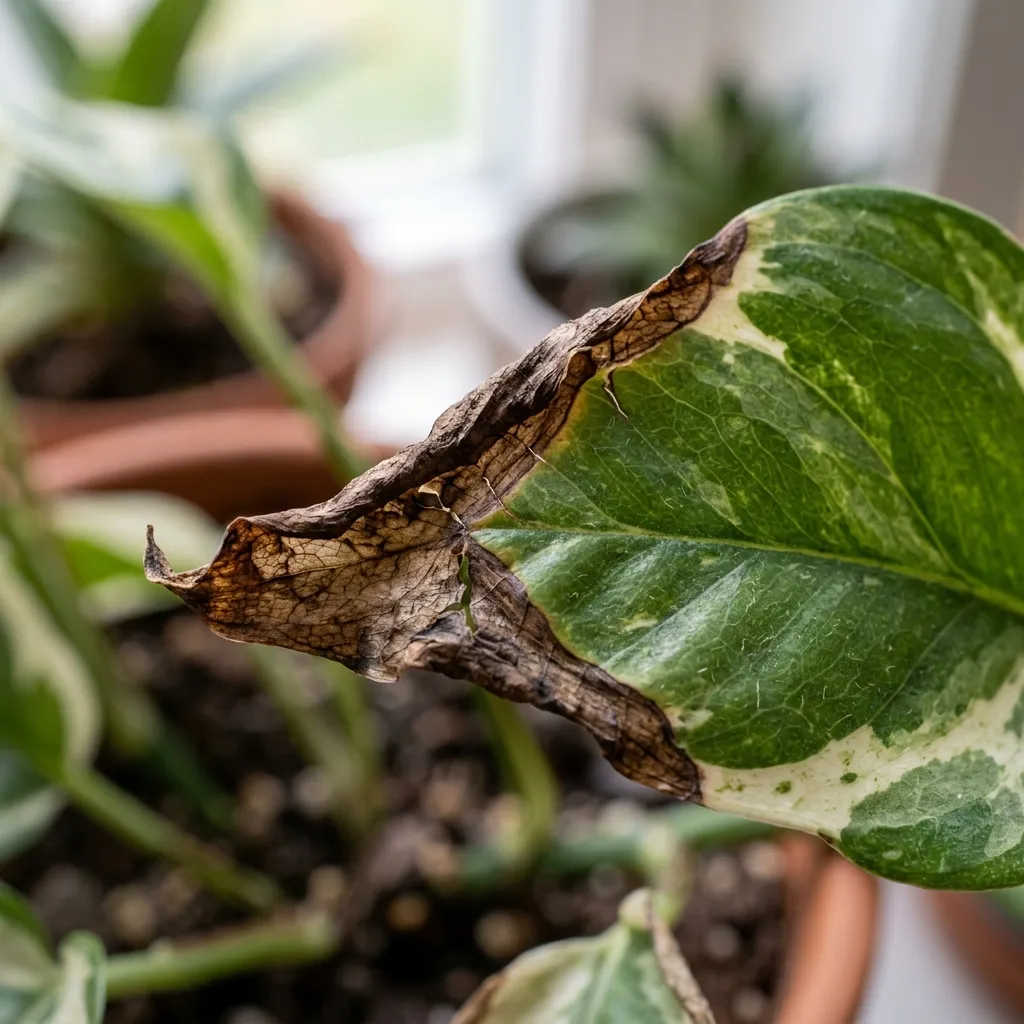
What Are Brown Tips on Bougainvillea?
Brown tips—those dry, crispy, discolored sections at the ends of leaves or bracts—are one of the most common frustrations for bougainvillea growers, and also one of the most misunderstood. I can't tell you how many times a worried gardener has sent me a photo of a plant with brown leaf tips, convinced it's a disease or a pest. Nine times out of ten, it's neither. Brown tips are a symptom, not a disease. They're the plant's way of saying, "Something in my environment is off, and I'm sacrificing my leaf margins to survive."
Unlike many other plants where brown tips might indicate old age or normal leaf senescence, bougainvillea are remarkably sensitive to certain stresses. When you see those crisp, tan-to-dark-brown edges creeping inward from the leaf tip, you're looking at the result of cell death in the leaf apex—the furthest point from the vascular supply. This can happen fast, sometimes overnight after a fertilizer application, or it can develop slowly over weeks from chronic low humidity.
Why does this matter specifically for bougainvillea? Because these plants are native to arid coastal Brazil and Peru, where they evolved in well-draining sandy soils, high light, and moderate humidity. When we grow them in containers, heated homes, or irrigated landscapes, we create conditions that stress their finely tuned water and salt management systems. Brown tips are often the first visible warning before more serious problems like leaf drop, stunted growth, or root damage. Beginners often ignore brown tips as cosmetic, only to lose the plant months later to root rot or fertilizer burn. Experienced growers see brown tips as a diagnostic opportunity.
For advanced hobbyists and collectors, brown tips can also signal subtle cultivar differences. Some bougainvillea varieties are naturally prone to tip browning in less-than-ideal conditions—'Barbara Karst' and 'San Diego Red' are relatively forgiving, while 'Pink Pixie' and 'Vera Deep Purple' will crisp at the edges if you look at them wrong. Knowing your cultivar's tolerance helps you decide whether to intervene or just accept a few crispy tips.
Why Brown Tips Matter for Bougainvillea Health
The appearance of brown tips isn't just an aesthetic issue—though let's be honest, a plant with perfect green leaves and vivid bracts looks a lot better than one with fried edges. Brown tips indicate underlying problems that, if left uncorrected, will affect flowering, root health, and overall vigor.
Flowering impact: When a bougainvillea is stressed enough to produce brown tips, it redirects energy away from bract production. The plant shifts into survival mode. You'll often notice that flowering diminishes or stops entirely in the weeks following the appearance of significant tip browning. In severe cases, existing bracts may fade or drop prematurely. I've seen gorgeous plants loaded with color go completely green within a month after a heavy salt burn incident.
Root health connection: This is critical and often overlooked. Many causes of brown tips—over-fertilization, salt buildup, inconsistent watering, and even low humidity—directly affect root function. Soluble salts accumulate in the root zone, creating osmotic stress that makes it harder for roots to take up water. The brown tips are the visible manifestation of a plant that can't transport enough water to its leaf margins. If you see brown tips, check the roots. Gently slip the plant out of its pot. Brown, mushy, or foul-smelling roots confirm that the problem started below ground.
Plant vigor and growth rate: Occasional minor tip browning on an otherwise healthy plant is no big deal. But chronic or severe browning stunts new growth. Leaves emerge smaller, internodes shorten, and the plant looks stunted. In container cultivation, this can persist for months even after correcting the cause because existing damaged leaves don't heal—you have to wait for new, healthy foliage to replace them.
Long-term health considerations: Repeated episodes of brown tips from over-fertilization can lead to permanent root damage and reduced lifespan. Bougainvillea can live for decades, but they're less forgiving of repeated salt stress than many other ornamentals. In landscape settings, brown tips often indicate irrigation water that's too high in salts or a need for deep leaching.
Container vs. landscape differences: Container-grown bougainvillea are far more prone to brown tips. Pots have limited soil volume, so salts concentrate faster. The same fertilizer dose that would be fine in the ground can burn a container plant. Also, pots heat up, which accelerates salt damage. In the ground, brown tips are more often caused by dry air (low humidity) or water quality issues because excess salts can leach deeper below the root zone.
Quick Facts: Brown Tips on Bougainvillea
| Factor | Details |
|---|---|
| Primary Causes | Fertilizer burn (salt buildup), low humidity (<40%), inconsistent watering, fluoride/chlorine in tap water |
| Visual Signature | Dry, crispy, tan to dark brown discoloration starting at leaf tip or margin; no yellow halo (unlike fungal spots) |
| Speed of Onset | Fertilizer burn: 1-3 days; low humidity: 1-2 weeks; watering issues: slow progression over weeks |
| Recovery Potential | High if cause corrected early; damaged leaf tips will not green again but new growth will be normal |
| Most Susceptible Growth Stages | Newly potted plants, actively growing plants in high heat, recently fertilized plants, indoor specimens |
| Cultivar Sensitivity (High to Low) | 'Pink Pixie', 'Vera Deep Purple', 'Rosenka' (high); 'Barbara Karst', 'Torch Glow', 'San Diego Red' (moderate); 'Crimson Jewel' (low) |
| Seasonal Peak | Late spring to early fall (active growth + fertilizer + heat); winter (indoor low humidity) |
Identification and Symptoms
Not every brown spot or crispy edge is the same. Learning to read the specific pattern of browning will tell you exactly what's wrong.
Early signs: The very earliest symptom is a subtle change in leaf color at the tip—usually a slight lightening or yellow-green appearance, then a dry, papery texture. You might also see small brown dots along the leaf margin. At this stage, the damage is reversible if you correct the cause. Many growers miss this and only notice when the leaf tip is fully brown and crispy.
Intermediate symptoms: Clearly defined brown tips that are dry and brittle, not mushy. The brown area is usually uniform in color (tan to dark brown) and stops abruptly along the leaf edge. There's no yellow halo or water-soaked appearance. The rest of the leaf remains green and healthy. This is classic tip burn from salt or humidity stress. At this stage, the damage is permanent on that leaf, but the plant overall can recover.
Advanced symptoms: Brown tips progress to cover one-third or more of the leaf surface. Multiple leaves affected. In severe cases, entire leaves turn crispy and drop off. New growth emerges with brown tips immediately, indicating ongoing stress. You may also see bracts browning at the edges. This stage often coincides with root damage.
Common misdiagnoses: The most frequent mistake is confusing brown tip burn with fungal leaf spot. Fungal spots are typically circular, irregularly scattered, and have a yellow halo or water-soaked margin. Tip burn is marginal and follows the leaf contour. Another misdiagnosis: normal leaf senescence. Older leaves at the base of the plant naturally yellow and drop over time, but they don't typically get crispy brown tips first—they fade evenly. Also, sunscald causes bleached or brown patches in the center or edges of leaves, but it's often accompanied by scorched bracts and affects the most exposed leaves first, not uniformly across the plant.
Visual clues for accurate diagnosis: Look at which leaves are affected. If brown tips appear on all leaves, young and old, suspect fertilizer burn or water quality. If only new growth is affected, suspect low humidity or inconsistent watering (new leaves are more sensitive). If only old leaves, check for normal senescence or root issues. Also, examine the roots: healthy roots are white to light tan; brown, mushy roots confirm overwatering/root rot as the underlying cause.
Causes and Contributing Factors
Let me walk you through the real-world causes I've encountered in hundreds of bougainvillea cases, from my own collection and from helping other growers.
Fertilizer burn and salt buildup (most common in containers): Bougainvillea are moderate feeders, but many growers over-fertilize thinking it will push more blooms. Synthetic fertilizers are salts. When you apply too much, or when you use high-nitrogen fertilizers repeatedly without leaching, salts accumulate in the potting mix. The osmotic pressure reverses, and water flows out of root cells instead of into them. The leaf tips, being the farthest point from the roots, show the damage first. I've seen plants burn from a single heavy dose of granular fertilizer on a hot day. Always water thoroughly before and after fertilizing.
Low humidity (indoor and arid climates): Bougainvillea prefer moderate humidity (40-60%). In heated homes in winter or in dry summer heat (Arizona, inland California), humidity can drop below 20%. The plant loses water through transpiration faster than it can take it up, even with moist soil. Leaf tips dry out and brown. This is especially bad for indoor plants near heating vents or on windowsills that get hot from sun. Many growers misdiagnose this as underwatering, so they water more, then get root rot.
Inconsistent watering (too dry then too wet): Bougainvillea like to dry out slightly between waterings, but they don't like extreme swings. If you let the soil go bone dry (leaves wilting), then drench it, the rapid change in soil moisture can cause tip browning from hydraulic stress. The leaf cells at the margins collapse. This is common with busy growers who forget to water for a week, then panic and soak the plant.
Water quality issues (fluoride, chlorine, high salts): Tap water in many municipalities contains fluoride (added for dental health) and chlorine/chloramine. Bougainvillea are sensitive to fluoride—it accumulates in leaf tips and causes a characteristic brown, scorched appearance. Well water or softened water can be high in sodium or other salts. Rainwater or reverse osmosis water eliminates this problem. Many collectors with sensitive cultivars use only rain or RO water.
Heat stress combined with dry air: When temperatures exceed 95°F (35°C) and humidity is low, transpiration rates spike. Even well-watered plants can develop brown tips if the roots can't keep up. This is common in summer in Mediterranean climates. Providing afternoon shade or misting can help.
Physical damage: Yes, sometimes it's that simple. Wind or handling can bruise leaf tips, and the bruised tissue dries and turns brown. This is usually isolated to a few leaves and not progressive.
Container-related factors: Small pots (less than 1 gallon) dry out and heat up faster, increasing all the above risks. Dark pots absorb heat. Poor drainage leads to salt accumulation because water doesn't flow through and out. Use pots with drainage holes and a well-draining mix (50% potting soil, 25% perlite, 25% coarse sand or pumice).
How to Diagnose and Fix Brown Tips
Follow these steps in order. Don't skip steps—the diagnosis determines the cure.
- Examine the pattern and affected leaves. Is it only tips? Whole leaf? Only new growth? Only old leaves? This narrows the cause. All leaves affected points to salt/water issues. Only new leaves points to low humidity or watering inconsistency.
- Check soil moisture and salinity. Stick your finger 2 inches into the soil. If it's bone dry, underwatering. If sopping wet, overwatering. Also, look for white crust on the soil surface or pot rim—that's salt buildup. If you have an EC meter (electrical conductivity), healthy soil reads below 1.5 mS/cm; over 2.5 mS/cm indicates excess salts.
- Leach the soil if you suspect salt buildup. This is the single most effective treatment. Take the plant to a sink or outdoors. Water slowly with 3-4 times the pot volume of room-temperature water (e.g., for a 1-gallon pot, use 3-4 gallons of water). Let it drain completely. This flushes out accumulated salts. Repeat once every 2-3 weeks if you use synthetic fertilizers.
- Adjust your fertilizer regimen. Stop fertilizing immediately. Wait until you see new, healthy growth without brown tips (usually 3-6 weeks). Then switch to a balanced fertilizer (10-10-10 or similar) at half the label strength. Or use an organic fertilizer like fish emulsion or compost tea—these don't cause salt burn. Apply only during active growth, and always water before and after.
- Increase humidity for indoor plants. Place the pot on a humidity tray (pebbles with water, pot not touching water). Group plants together. Use a cool-mist humidifier nearby. Mist the leaves daily in the morning (but not in high heat to avoid sunburn). In dry climates, moving the plant to a bathroom with a window can work wonders.
- Switch to rainwater or filtered water. If you suspect fluoride or chlorine, leave tap water out overnight (chlorine evaporates, but chloramine doesn't) or use a carbon filter. Better yet, collect rainwater. For valuable specimens, use reverse osmosis water. Test by watering one plant with rainwater for a month—if new growth is tip-burn-free, water quality was the issue.
- Stabilize your watering routine. Water deeply when the top 2 inches of soil are dry. Don't water on a fixed schedule. In summer, that might be every 2-3 days; in winter, every 10-14 days. Use a moisture meter if you're unsure. Always water until it runs out the drainage holes.
- Consider repotting for severe cases. If tip burn is extensive and leaching didn't help, repot with fresh, well-draining mix. Trim off any brown, mushy roots. Use a slightly larger pot (only 1-2 inches bigger). Don't fertilize for 4-6 weeks after repotting.
- Prune damaged leaf tips only for aesthetics. Brown tips won't heal, but you can trim them off with clean scissors. Cut just into the healthy green tissue at an angle that mimics the leaf shape. This makes the plant look better and removes potential entry points for diseases—though brown tip tissue itself isn't infectious.
Common Mistakes Growers Make with Brown Tips
- Panic fertilizing. When they see brown tips, many beginners assume the plant is hungry and add more fertilizer. This makes salt burn worse, fast. Always stop fertilizing first.
- Watering more frequently. If the cause is low humidity, more water won't help—it may cause root rot. Check soil moisture before increasing water.
- Cutting off all damaged leaves immediately. The plant still needs those leaves for photosynthesis. Only remove leaves if more than 50% is brown. Otherwise, leave them until new growth appears.
- Ignoring the root zone. Brown tips often have root causes (pun intended). If you only treat the leaves, you'll never fix the problem. Check roots, check drainage, check salt levels.
- Using softened water. Water softeners replace calcium and magnesium with sodium. Sodium is even worse for bougainvillea than hard water salts. If you have a water softener, use an outdoor spigot that bypasses it for your plants.
- Applying foliar sprays on damaged leaves. Brown tips indicate stressed tissue. Spraying with neem oil, insecticidal soap, or even fertilizer can cause additional burn. Wait until new healthy growth emerges.
- Assuming all brown tips are the same. A plant with brown tips from low humidity needs different care than one with salt burn. Diagnose before you act.
Expert Tips from Experienced Growers
After years of growing bougainvillea in coastal Southern California, inland valleys, and a stint in humid Florida, here's what I've learned about brown tips that isn't in the textbooks.
Salt buildup is worse in clay pots. Yes, clay breathes, but it also absorbs salts from fertilizer and water. Over time, the pot itself becomes a salt reservoir. When you water, some of those salts redissolve and burn roots. If you grow in clay pots and have chronic brown tips, consider switching to plastic or glazed ceramic, or leach your clay pots by soaking them in fresh water overnight once a year.
Morning watering reduces tip burn in summer. Watering in the morning allows the plant to take up water before the heat of the day. Evening watering leaves the plant wet overnight, which isn't the problem, but morning watering gives the plant maximum hydration when transpiration is highest. In my trials, morning-watered plants had significantly less tip burn during heat waves.
Brown tips on bracts are different. Bracts (the colorful modified leaves) are more sensitive than true leaves. Brown tips on bracts usually indicate direct physical damage (wind, handling) or the natural aging process. Old bracts brown at the edges as they senesce—that's normal. But if new bracts have brown tips, suspect low humidity or salt stress.
Silica supplements can reduce tip burn. Some experienced growers add potassium silicate (silica) to their watering routine. Silica strengthens cell walls and improves the plant's tolerance to salt stress and heat. Use a product like AgSil 16H at 50 ppm Si. It's not a cure-all, but it reduces tip burn in high-heat climates. I've used it on my 'Pink Pixie' collection with noticeable results.
Cultivar-specific observations: 'Rosenka' (golden bracts) is notoriously sensitive to fluoride. Even low levels in tap water cause tip burn within weeks. If you grow 'Rosenka', use rainwater or RO water exclusively. 'Torch Glow' (compact red) is surprisingly tolerant of salt and dry air—it's my go-to recommendation for indoor growing. 'Pixie' series (dwarf) develop brown tips easily from under-watering because their small pots dry out fast.
Winter indoor tip burn is almost always humidity, not fertilizer. In winter, we stop fertilizing, but indoor humidity drops to 20% or less. The brown tips you see in January are from dry air, not salt. Run a humidifier near your overwintering bougainvillea, or group them with other plants to create a microclimate.
Copper fungicides can cause tip burn. If you've applied copper-based sprays for bacterial leaf spot, you might see brown tips afterward. Copper is toxic in excess. Use only as directed, and don't apply in hot weather (above 85°F). Rinse the leaves with water the next morning.
Troubleshooting Guide
| Problem | Likely Cause | Solution |
|---|---|---|
| Brown tips on all leaves, white crust on soil surface | Fertilizer salt buildup | Leach soil with 3-4x pot volume of water. Stop fertilizing for 6 weeks. Switch to half-strength or organic fertilizer. |
| Brown tips only on new growth, rest of plant looks fine | Low humidity (indoor winter) or inconsistent watering | Increase humidity with tray or humidifier. Water when top 2 inches dry, not on schedule. Mist daily. |
| Brown tips plus yellowing lower leaves, wet soil | Overwatering leading to root stress | Repot with dry, well-draining mix. Cut back water. Remove mushy roots. Do not fertilize. |
| Brown tips that are soft and dark, almost black | Cold damage or frost | Move to warmer location. Prune damaged growth in spring. Not reversible; wait for new growth. |
| Brown tips appear 1-2 days after fertilizing | Fertilizer burn from too much or too strong | Leach immediately. Flush thoroughly. Do not fertilize again for 8 weeks. |
| Brown tips on one side of plant only | Salt or chemical exposure (e.g., from a wall, sidewalk de-icer, pet urine) | Leach soil. Flush the area. If near a treated wall, consider moving the plant. |
| Brown tips with tiny brown spots scattered on leaves | Fluoride toxicity (common with 'Rosenka') | Switch to rainwater or RO water. Leach soil. Add calcium (gypsum) to bind fluoride. |
| Brown tips on lower leaves only, upper leaves fine | Normal senescence or salt accumulation at bottom of pot | Remove old leaves. Leach soil to prevent upward progression. Ensure drainage holes aren't blocked. |
Frequently Asked Questions
Can brown tips on bougainvillea turn green again?
No. Once leaf tissue turns brown and crispy, it's dead. The cells have collapsed and won't recover. Don't waste time with remedies claiming to "heal" brown tips. Instead, focus on preventing further browning on new leaves. You can trim the brown tips off for appearance, but the leaf will always have a clipped edge.
How often should I leach my potted bougainvillea to prevent brown tips?
If you use synthetic fertilizers, leach every 4-6 weeks during the growing season (spring through fall). If you use organic fertilizers or slow-release pellets, leaching once in mid-summer and once before bringing plants indoors for winter is sufficient. In winter when growth slows and you're not fertilizing, no need to leach unless you see salt crust.
Is it normal for bougainvillea to have a few brown tips?
A very small number of minor brown tips (less than 5% of leaves, just the very tip) on an otherwise thriving plant isn't a concern. Perfect leaves are rare in real-world conditions. But if brown tips are widespread, worsening, or appear on new growth, investigate the cause.
Will pruning off brown tips help the plant?
Pruning brown tips is cosmetic only—it doesn't help or hurt the plant's health. However, if the brown tip extends into a large portion of the leaf, removing the damaged tissue can prevent any potential fungal entry (though tip burn alone isn't infectious). Use sharp, clean scissors and cut just into healthy tissue at a natural angle.
My bougainvillea has brown tips but I water correctly and use rainwater. What else?
Check for these less common causes: 1) Rootbound condition—roots circling the pot can't take up water efficiently. Repot if roots fill the container. 2) Heat reflection—if pot is against a south-facing wall, radiant heat can cook roots and leaf tips. Move pot 6 inches away. 3) Terracotta pot wicking moisture away from root ball. Switch to plastic or add a liner. 4) Recent transplant shock—newly repotted plants often get temporary tip browning while roots establish.
Can brown tips spread to other leaves or plants?
No. Brown tip burn is abiotic (non-living cause). It's not contagious. You don't need to isolate the plant. However, if the underlying cause is a fungus or bacteria that also produces brown tips (rare on bougainvillea), that would be different. But true brown tip burn doesn't spread.
Should I remove leaves with brown tips before winter storage?
If you're overwintering bougainvillea in a cool, dark space (e.g., garage or basement), you can remove badly damaged leaves to reduce the chance of botrytis or other fungal issues in stagnant air. Leave healthy leaves. Don't strip the plant bare—it still needs some foliage for minimal photosynthesis even in dormancy.
What's the best fertilizer to avoid brown tips?
For container bougainvillea, I recommend a slow-release organic fertilizer like 5-5-5 with added micronutrients, or a liquid fish/kelp emulsion (diluted to half strength). Synthetic fertilizers work fine if you use them sparingly and leach regularly. Avoid high-nitrogen formulas (like 30-10-10) and "bloom boosters" with very high phosphorus—both can burn more easily. Osmocote Plus (14-14-14) at half the recommended rate is a reliable synthetic option.
Related Bougainvillea Topics
- Fertilizer Burn Prevention and Treatment
- Managing Indoor Humidity for Bougainvillea
- Water Quality: Tap, Rain, RO, and Softened Water
- Root Rot: Symptoms, Causes, and Recovery
- Preventing Leaf Scorch in Hot Climates
- Container Drainage and Salt Management
- Special Care for Variegated and Sensitive Cultivars
- Overwintering Bougainvillea Indoors
Summary
Brown tips on bougainvillea are almost always a sign of environmental stress—most commonly fertilizer salt buildup, low humidity, or inconsistent watering. The good news is that brown tips are rarely fatal and the plant will recover once you correct the underlying cause. The damaged leaf tips won't heal, but new growth will be healthy if you follow the diagnostic steps: identify the pattern, check soil moisture and salt levels, leach if needed, adjust watering and humidity, and stop fertilizing until the plant recovers.
My strongest advice: don't overreact. Resist the urge to douse the plant with fertilizer or water. Instead, think like a detective. Look at the whole picture—the affected leaves, the pot size, the growing environment, your recent care routine. Nine times out of ten, the cause is something you did (or didn't do) in the past two weeks. Correct that, and your bougainvillea will reward you with clean, healthy foliage and, eventually, those spectacular bracts.
For container growers in particular, make leaching a regular part of your maintenance routine. And if you're growing sensitive cultivars like 'Rosenka' or 'Pink Pixie', invest in a rain barrel or RO filter. Your plants will thank you with flawless leaves and abundant color.
Related Plants
Plant Guide
Chocolate Brown
This Chocolate Brown bougainvillea is valued for its bronze to coppery brown bracts and its distinctive collector cultivar best kept in strong sun. In warm tropical and subtropical gardens, it performs as a resilient ornamental climber that rewards full sun, sharp drainage, and a restrained feeding regime with long flushes of colour.
Plant Guide
'Elizabeth Angus' (Purple Bougainvillea)
Bougainvillea 'Elizabeth Angus' is a popular and vigorous cultivar prized for its spectacular deep purple bracts and glossy, dark green foliage. A prolific bloomer for hot, full-sun gardens, fences, and containers across tropical and subtropical climates.
Plant Guide
Eva Variegated
This Eva Variegated bougainvillea is valued for its mixed pink, cream, orange, or white tones bracts and its best grown in bright sun to preserve leaf variegation and vivid bracts. In warm tropical and subtropical gardens, it performs as a resilient ornamental climber that rewards full sun, sharp drainage, and a restrained feeding regime with long flushes of colour.
Plant Guide
Golden Summer Tricolour
This Golden Summer Tricolour bougainvillea is valued for its mixed pink, cream, orange, or white tones bracts and its best grown in bright sun to preserve leaf variegation and vivid bracts. In warm tropical and subtropical gardens, it performs as a resilient ornamental climber that rewards full sun, sharp drainage, and a restrained feeding regime with long flushes of colour.
Plant Guide
Rainbow veriegated
This Rainbow veriegated bougainvillea is valued for its mixed pink, cream, orange, or white tones bracts and its best grown in bright sun to preserve leaf variegation and vivid bracts. In warm tropical and subtropical gardens, it performs as a resilient ornamental climber that rewards full sun, sharp drainage, and a restrained feeding regime with long flushes of colour.
Plant Guide
Tri Color Verigated
This Tri Color Verigated bougainvillea is valued for its mixed pink, cream, orange, or white tones bracts and its best grown in bright sun to preserve leaf variegation and vivid bracts. In warm tropical and subtropical gardens, it performs as a resilient ornamental climber that rewards full sun, sharp drainage, and a restrained feeding regime with long flushes of colour.
Related Articles
Guide
Basic Bougainvillea Care: Complete Global Guide for Vibrant Blooms
Complete global guide to basic bougainvillea care: sunlight (6–8 hours), dry-down watering, pruning for blooms, low-nitrogen fertilizer, and troubleshooting common problems.
Guide
Why Your Bougainvillea is Dropping Leaves (And How to Save It)
Bougainvillea leaf drop is usually a stress signal, not a death sentence. This guide explains the most common causes, how to diagnose them quickly, and the exact steps to restore growth before the plant declines further.
Guide
Best Fertilizer for Bougainvillea: Feed for Bracts, Not Leaves (Global Guide)
Global guide to bougainvillea fertilizer: organic vs synthetic, low-nitrogen NPK ratios, feeding schedules for pots and ground, and how to trigger heavy blooms without excess leaf growth.
Guide
Early Identification of Common Bougainvillea Diseases and Effective Responses
Learn to spot early signs of bougainvillea diseases: leaf spot, root rot, and dieback. Practical treatment tips for high-humidity tropical and monsoon conditions.
Guide
How to Make Bougainvillea Bloom: The Sun-Stress-Prune Method (Global Guide)
Global guide to trigger heavy bougainvillea blooms using the sun-stress-prune method: full sun, controlled dry spells, strategic pruning, and low-nitrogen fertilizer.
Guide
Common Bougainvillea Problems & Fixes: Root Rot, No Blooms, Yellow Leaves (Complete Guide)
The 8 most common bougainvillea problems diagnosed and fixed: root rot, no blooms, yellow leaves, leaf drop, leggy growth, pests, powdery mildew, and overwatering. Each entry includes symptoms, cause, exact fix, and expected recovery time.
Related Calculators & Tools
Calculator
Bougainvillea Heat Stress & Watering Calculator
Diagnose heat stress in potted Bougainvilleas during extreme summer weather.
Calculator
Bougainvillea Watering Schedule Calculator
Calculate exactly when to water your Bougainvillea using the proven Dry-to-Bloom method.
Calculator
Bougainvillea NPK Fertilizer Calculator
Analyze your fertilizer NPK ratio to ensure it promotes Bougainvillea blooms rather than just green leaves.
Calculator
Bougainvillea Neem Oil & Pest Calculator
Calculate precise neem oil dilutions to eradicate Bougainvillea Loopers and aphids.
Calculator
Bougainvillea Potting Mix Calculator
Calculate the exact volumes of perlite, compost, and soil for a fast-draining Bougainvillea mix.
Calculator
Bougainvillea Soil pH Calculator
Calculate amendments to reach the ideal 5.5 - 6.5 pH for Bougainvillea nutrient uptake.